When Roma Nazimov first flew to Thailand, he told his mum: “Mama, we’re in paradise.” Elena Pogrebizhskaya used that phrase as the title of her documentary about the deaths of Roman and Diana Nazimov near Pattaya. It came out on 17 September on the Istorii bez sakhara (“Stories Without Sugar”) channel: an hour and twenty minutes of conversation with the mother, Zarina Nazimova, the volunteers who searched for the two of them, and the man who coordinated the volunteers with the police. The film calls him Viktor; his name and voice have been changed.
In August we went through this case using a transcript of the Thai live broadcast: how, according to investigators, Pong and Thong posed as police and took five people away, what they admitted and where investigators did not believe them. The film looks at the same story from the family’s side. It contains a great deal that was neither in the Thai broadcast nor in the press.
A caveat you need before reading any further. Almost everything in the film that casts doubt on the official version is said by the mother and the anonymous Viktor. There are no investigation documents on screen: there is camera footage and there are the volunteers’ accounts. Thana Kerdthong (Pong) and Thongchai Srinil (Thong) are on trial: in October both pleaded guilty to all the charges, but there is no verdict yet. In what follows, it is important to keep apart what has been established, what is retold second-hand and what is assumed.
Who Diana and Roman Nazimov were
The family moved to Thailand from Tyumen. At first they came as tourists, then they stayed. They lived in a gated residential complex in Huai Yai, in the south of Pattaya: security guards, cameras, a quiet area.
Diana was 22. After nine years of school she trained as a videographer and was soon in demand: steady commissions, her own page, music videos for local rappers. She usually shot at night. Roma was 17 and studied online, and by temperament he was her opposite: reserved, with two friends, one Russian and one Thai. He dreamed of becoming a pilot and loved heavy motorbikes, jet skis, fishing and diving. He spoke English without an accent.
According to the film, Zarina is 40 and raised her children on her own. Later her father moved to Pattaya to join the family.
What happened on the night of 25–26 July
On the evening of 25 July 2026, Zarina went to Bangkok for a morning meeting and stayed there overnight. The children and their grandfather were at home.
That night Diana had gone out to look at locations for a shoot. On the way home she heard a loud, low hum in the earphones under her helmet, like the roar of a motorbike in the wind. The sound drowned out her music, although there was no one nearby. She recorded video messages to her mum about it. These were her last messages to her mum.
About fifteen minutes after she got back, Diana’s iPhone warned her that an unknown Bluetooth tracker was nearby and had travelled her whole route with her. The same notification had come on Friday, but she had not opened it then. She had rented the bike on 16 July, and until that Friday there had been no such notifications. Diana recorded two video messages to a family friend, Dmitry: she was scared and felt she was being followed. She did not wake her mum. She decided the tracker most likely belonged to the rental company and planned to message them in the morning.
About half an hour later, at 4:02, Diana and Roma left the complex on her Honda ADV. The camera at the exit shows them in a good mood. Both were in the clothes they wore around the house, without helmets, bags or documents. According to their mum, dressed like that they would go no further than 7-Eleven; for a meeting Diana would have dressed differently. Being awake at four in the morning was normal for them: Diana worked at night, and Roma’s sleep had been thrown off by a night-time drive back from Phuket. What was unusual was something else: Roma was the one riding, and he did not like scooters.
In August it was reported that the two had gone to watch the sunrise. The film does not include that version: where they went at 4:02 and why is still unknown.
19 minutes without cameras: what the footage shows
A couple of minutes after they left, a camera 300 metres from home films them at a leisurely pace. Then there is a gap: the next recording is not until 4:21. Those nineteen minutes, from leaving at 4:02 to the recording at 4:21, are the film’s main question.
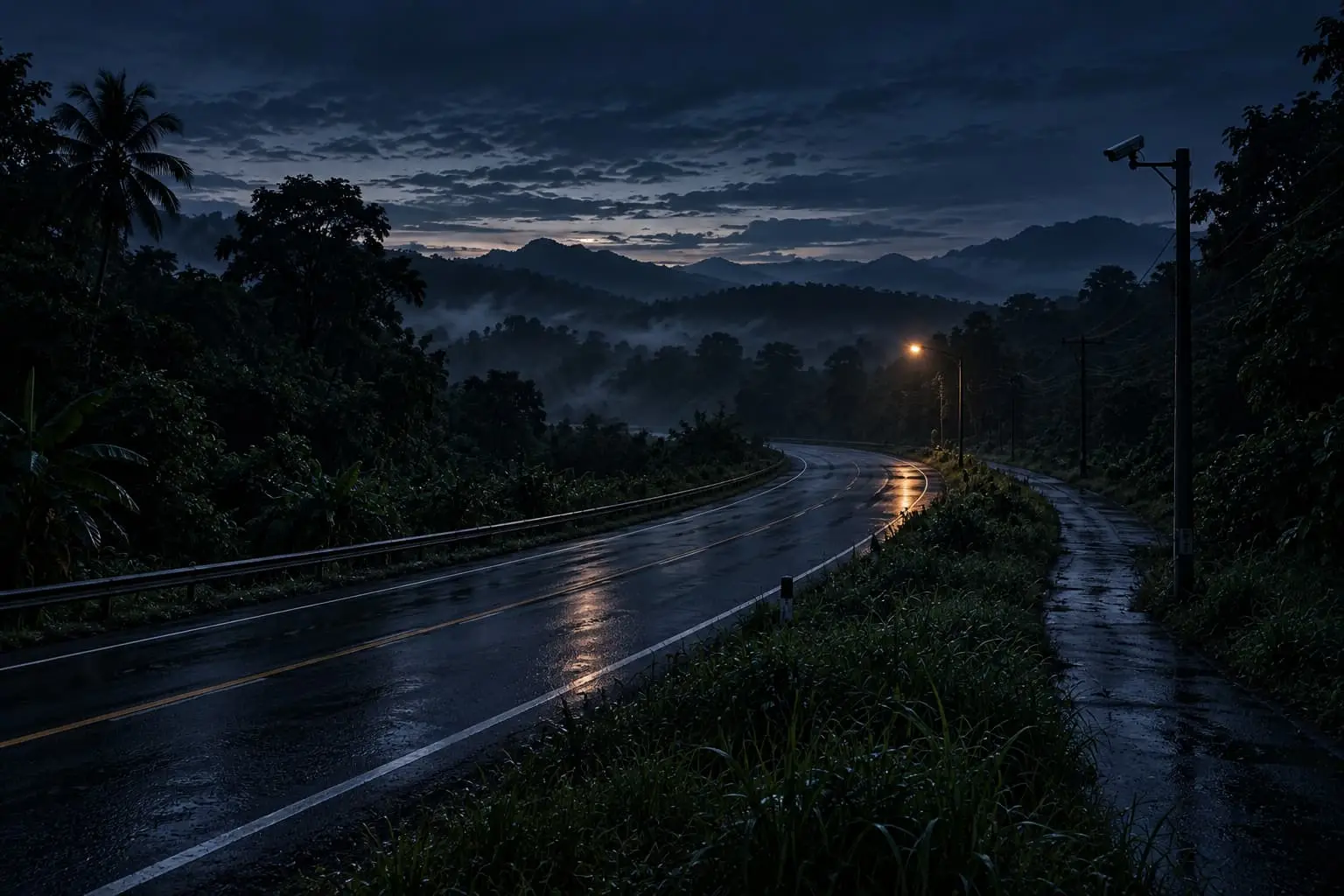
At 4:21 a camera by Motorway 7 and its frontage road films two bikes riding close together. The first, presumably the siblings’ bike, pulls out into the middle of the main road and stops. A passenger whose height resembles Roma’s walks towards the middle of the road, comes back and gets on behind. The second bike waits on the frontage road at the kerb. Then the first moves onto the frontage road against the traffic, the second pulls up to it, and, judging by the headlights, the siblings’ bike falls on its side. The volunteers believe it was kicked over.
At 4:26 Diana sends a single word: “Urgent.” Not to her mum, as the press reported, but to Dmitry. He was online but had already fallen asleep.
Nine minutes later both bikes are caught on camera for the last time, now moving fast. The volunteers processed the video and concluded that Diana, in a red T-shirt, and Roma are sitting as passengers, while strangers are riding the bikes.
The search for the Nazimovs: at first the family searched alone
In the morning Zarina got hold of her father and learned that the children were not at home. During the two-hour drive back from Bangkok she wrote a letter to the tourist police. The complex’s security handed over the 4:02 exit footage straight away.
At the Huai Yai police station, according to Zarina, she was told to wait 24 hours, especially as it was the weekend. The consulate replied that it had no authority and sent her to the police. Zarina rang round and drove round the hospitals. On the night of 26–27 July she found the footage from the camera by the motorway and at half past four in the morning brought it to the station. By her account, the answer she got was: “Tomorrow.”
Until 28 July the only people looking for the two of them were family and friends. All that time, according to Zarina, she did not eat, did not sleep and did not even sit down.
From 28 July volunteers from the Russian-speaking community joined in; the next day a search headquarters was set up, and LizaAlert helped remotely. The area was combed in a line with two to three metres between people; abandoned houses were checked, locals were questioned through interpreters, drones went up, camera footage was collected. Around a hundred people gathered at Zarina’s house.
There were false leads too. Bloodstains on the road turned out to be from someone else’s accident. Someone started a rumour that refuse collectors were taking two bodies to the Huai Yai station, and some of the volunteers went there together with the police. Viktor says he knows the author of that rumour by name. The theories kept changing: human trafficking, a scam centre, organs. The last was soon dropped, but kidnapping for ransom was held onto until the end.
How the bike was found and the suspects identified
On Wednesday, 29 July, detectives from Chonburi arrived at the station. In the back of a pickup they brought a woman, and twenty minutes later they left wearing body armour. The woman pointed to a garage where stolen bikes were broken up. The garage owner said that on Tuesday a stranger had offered him this bike: supposedly he had taken it in payment of a 60,000 baht debt and wanted to sell it. Viktor thinks this story is a lie: in Huai Yai, with around 30,000 residents, “a certain kind of people” all know each other by sight.
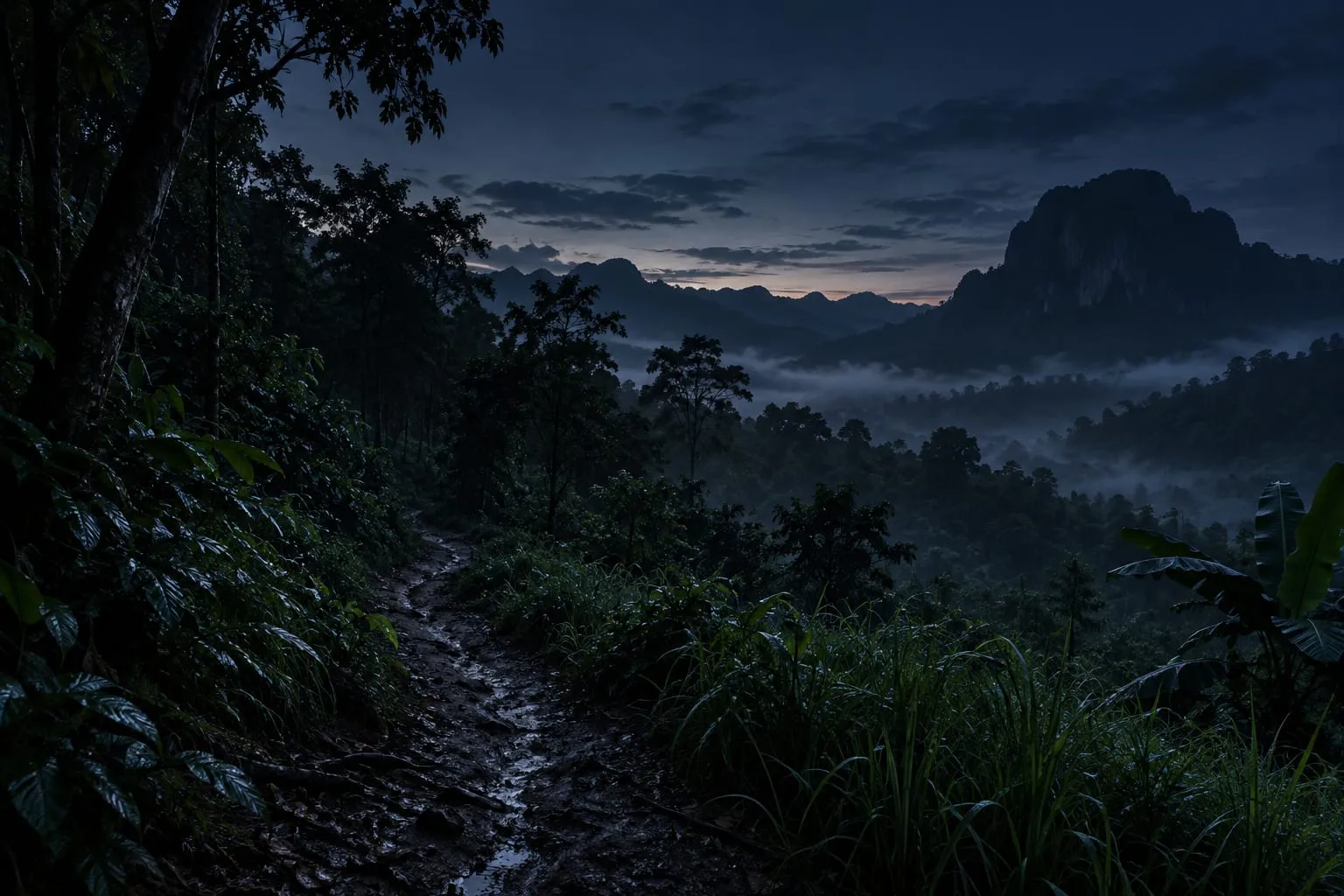
According to the film, the bike was found dismantled and buried in two pits in the woods, six kilometres from the last camera, and not near the suspect’s home, as some media reported. One pit held the fork, the engine and the cut-up number plate in a bag; the other held the plastic body panels. The volunteers describe the place as an old cemetery with dug-up and caved-in graves and fire pits.
According to Viktor, Pong had been released on parole not long before, on 4 June. The Department of Corrections said otherwise as early as 1 August: Pong was released on 5 June after serving his full sentence, but under two years’ court-ordered supervision. Of Thong, people in the film say that he lived in a lean-to shelter not far from where the bike was buried.
Pong’s sister, as Viktor tells it, said that on 26 July at around ten in the morning the two of them came to her “filthy as hell”, washed, did their laundry and left. Pong was wearing a police uniform and carrying a gun.
On 31 July, the sixth day, both were arrested in Sa Kaeo province, near the Cambodian border. According to the police, they confessed to the robbery and murder.
The official version: what the suspects said
In the film, the official version is set out on the basis of the suspects’ statements. According to this version, they met the two by chance on the motorway and decided to take the bike. They said they were police, handcuffed Roma and took the brother and sister away on separate bikes, “to the station”. When the two realised they were not going to the police, a fight broke out. According to these statements, Pong shot Roma in the stomach, then in the head; Diana was beaten unconscious and strangled. In the film her mother says it was done with her brother’s T-shirt. By the suspects’ own account, they had no intention of letting them go, because the two “would have filed a report”.
One detail from the statements, which Zarina relays from what a police officer told her, sits badly with a “random robbery”: that morning the two men “already wanted to kill someone, but couldn’t find the person they were looking for”.
The suspects themselves showed where the bodies were buried. After six days the bodies had deteriorated badly, and they were taken to Bangkok for examination. Zarina says she identified her children only on 3 August: Diana by a tattoo, Roma by moles on his leg. According to the police, the suspects also confessed in the case of the murder of a Thai family a few weeks earlier. Two more people are charged in that case, and we wrote about it in detail last time. The police officer, Zarina says, called the common feature a “signature”: all the victims had their hands and feet tied.
The questions the film raises about the investigators’ version
The film’s main argument: in the view of the people in it, the investigation relies solely on the version told by the suspects, while the answers lie in those nineteen minutes before the motorway. We do not have the case files, so we cannot check this. The questions raised by Viktor, the volunteers and the mother fall into three groups.
The road
Speed. If all nineteen minutes were spent on the road to the motorway, the two were riding at about 18 kilometres an hour. For a motorbike that is almost walking pace. Viktor suggests they stopped somewhere. According to him, the police did not seize at least six cameras on that stretch that could have shown it, nor the dashcam footage of passing cars.
The tracker. The rental company’s GPS tracker stopped working at 4:03, a minute after they left. The siblings did not know where it was fitted. Hence Viktor’s theory: Diana was being followed, they were stopped almost outside their home and, under the pretext of inspecting the bike, the trackers were removed. The hum in her earphones, according to the film, may have been interference from a second tracker that was not hers. Diana looked for it but did not find it.
The dogs. Roma was afraid of street dogs; they had bitten Zarina before. According to his mum, he would not have ridden at night through dark village lanes to Motorway 7 of his own free will.
Who was riding. On a turn, the rider paddles their feet along the tarmac, and Thais, according to Viktor, don’t ride like that. So Viktor suggests that Diana was already the one riding, with the second bike following 50–70 metres behind. In that case, in his view, it is unclear why the brother and sister were not separated straight away.
The missing fragment. According to Zarina, in the first version of the recording Roma leans down and picks something up from the tarmac. By her own account, at least eight people saw this fragment, and it is missing from later versions of the recording. This cannot be checked from the film. Viktor allows that an electronic key may have fallen off the bike.
Why they didn’t jump off. By the dirt track at the latest, according to the film, it became clear they were not being taken to the police. Yet neither Roma nor Diana jumped off the bikes.
Place and time
The shots. A fisherman by a lake and a hermit monk, according to people in the film, heard shots. The fisherman may have meant not five in the morning but five in the evening. If so, the two could have been kept alive all day. The forensic results, the film says, are not ready yet and, because of the state of the bodies, may not give a precise answer.
The phones. The film says the police reported the signal being lost by the lake, but divers found nothing. At home Roma had a spare phone with syncing, and the last location there is the monk’s hut. He was questioned and his home was inspected. There is no information that he is suspected of anything, and in itself this says nothing about any involvement.
The burial site. The volunteers say it is a dead end in grass up to your shoulders that even locals did not know about. They checked: you cannot get there by motorbike. Hence their conclusion that the two may well have been killed somewhere else.
Caustic soda. During the search, the volunteers went into a hut that, they say, people had just run out of, and found sacks of caustic soda there. Viktor puts forward the theory that it may have been used on the bodies to speed up decomposition and destroy DNA and traces of torture. In his view, this would explain why the bodies became unrecognisable in five or six days. The film offers no confirmation of this theory.
The people
Hands. The suspects say they beat Diana with their hands, but, according to the film, no grazes can be seen on their hands at the time of arrest.
The uniform. The film claims that for almost two months after his release Pong went around in a police uniform with a weapon and aroused no suspicion. His former girlfriend speaks of Pong’s links with two police officers from Huai Yai. A possible “patron”, whose identity has not been established, is also mentioned; the film refers to an internal inquiry. On 4 August the national police chief ordered these claims to be checked. A witness picked out two similar-looking officers from photographs but did not positively identify anyone. An officer mentioned in the press publicly denied any link with Pong and said he had arrested him twice himself, in 2018. And Chonburi police, as Thai Examiner reported in October, stated that the inquiry had found no links between the accused and serving police officers. Reports that police officers had been detained were not confirmed. Neither the film nor any public source contains evidence that police officers were involved.
A tip-off. The young woman rode around at night on a motorbike, possibly with expensive filming equipment, and the family had money. Viktor says he sees no arguments against the theory that the victims were chosen in advance.
Why it was Roma and Diana who died, the film does not answer, and it says so openly.
The harassment of the mother on social media
Alongside the search, a harassment campaign was running on social media. People picked apart Zarina’s looks and outfits, wrote that she “owed money to pimps”, that the children were “drug couriers”, that the whole thing was fake. At night people came to her place to check whether the children really were missing.
One woman filmed a video outside the morgue, claiming the mother was in no hurry to identify the bodies. In fact Zarina was waiting for a document to be allowed in, and the bodies had been taken straight to Bangkok; they were never in the Pattaya morgue. Some of the authors of such posts later apologised. Zarina’s circle wants to take legal action against the rest under defamation law.
Where things stand now
The farewell and cremation were held with monks. One of them wept and could not recite the chants. Zarina wants to scatter the children’s ashes: some of Diana’s over the sea, some of Roma’s in the mountains.
She has stayed in Thailand and is pressing for an answer to what happened in those nineteen minutes. Viktor says this is why many people now find her “inconvenient”. She considers life imprisonment or the death penalty, which the accused may face, too light a punishment.
At the end of the film it is stated that the Royal Thai Police have scrapped the rule of waiting 24 hours before a missing-person report. More precisely: on 19 August the national police chief, Pol Gen Kittirat Phanphet, ordered all stations to accept missing-person reports immediately and barred them from citing the need to wait 24 hours.
What was known before the film, and what it reveals for the first time
Before the film came out, the press had already reported the arrest on 31 July and the confessions, the use of a police uniform, the murder of the Thai family, the prime minister’s visit and the inquiry into Pong’s possible links with the Huai Yai police. These are media and police reports, not a court ruling: there has been no verdict in the case.
What is new in the film is almost everything to do with the doubts: the hum in the earphones, the iPhone’s warning about an unknown tracker, the tracker going dead a minute after they left, the gap from 4:02 to 4:21 and the cameras not seized, the missing fragment of footage, the phone at the hut, the caustic soda, the account of Pong’s sister. All of these are claims by the mother, the volunteers and an anonymous source. On at least three points the film diverges from the press: “Urgent” did not go to the mother, the bike was not found near the suspect’s home, and the bodies were never held in Pattaya.
The main thing is still not established: what happened in those nineteen minutes, where and when the two were killed, and whether Pong and Thong acted alone. The forensic results, the film says, are not ready.
What happened next
On 30 September prosecutors sent the case to the Pattaya court. The indictment has nine charges, and among them is one that was not in the first police reports: the armed rape of Diana, resulting in death. According to Zarina, investigators had at first told her there had been no rape. In early October she asked the police in writing for the forensic results and what the charge was based on. By her account, she has had no substantive answer.
On 1 October Pong and Thong still denied murder; on 20 October they pleaded guilty to all nine charges. The court admitted Zarina to the proceedings as a co-plaintiff on the rape and murder charges. In the Thai family’s case, four accused, Pong and Thong among them, pleaded guilty to all the charges on 26 October. There is no verdict in either case: the court will hear the evidence on 23 November in the Thai family’s case and on 30 November in the Nazimov case.
The whole film is on YouTube (in Russian). If you know something about that night, about that stretch of road or about the recordings from those cameras, don’t retell it in the comments, bring the source: in the community chat (in Russian) we will help you work out who to pass it to.