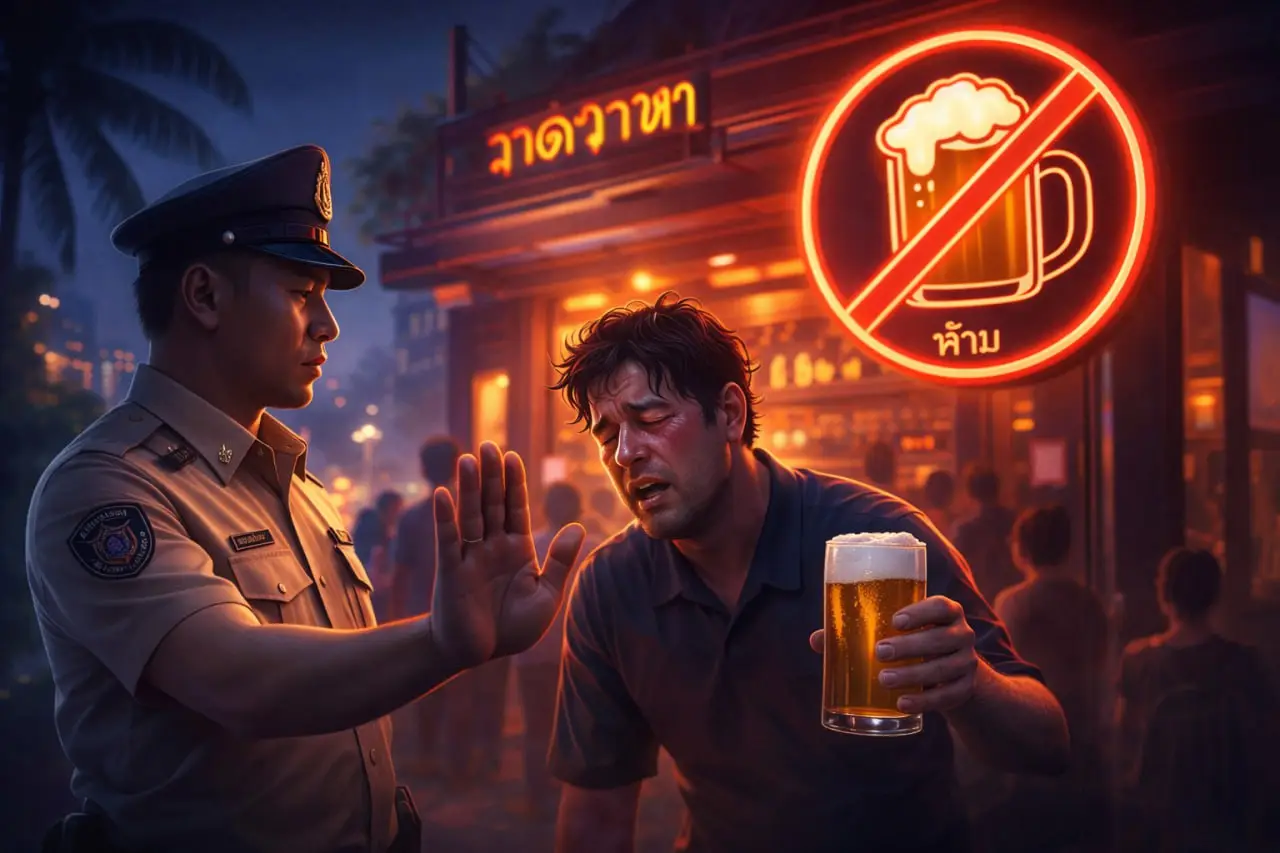
Since 8 November 2025, anyone selling alcohol in Thailand must refuse a customer who shows signs of being drunk and must check the buyer’s age. If they sell to a drunk person who then harms someone, the seller is liable for that harm in a civil claim, and for the breach itself they face up to a year in prison or a fine of up to 100,000 baht. Since March 2026 the signs of drunkenness have been set out in an official checklist. Alcohol is sold from 11:00 to 24:00, and a customer still drinking in a bar after the cut-off faces a fine of up to 10,000 baht.
What changed in the law
Selling alcohol to drunk people in Thailand has been banned since 2008, but the ban used to cover only someone drunk “to the point of losing self-control”. An amendment to the Alcoholic Beverage Control Act, published on 9 September 2025, made the rule stricter:
- the threshold is lowered to “signs of drunkenness”;
- the seller must check both age and drunkenness, and ask for ID if in doubt about age;
- the penalty has gone up to a year in prison, a fine of up to 100,000 baht, or both. The fine used to be capped at 20,000 baht;
- a venue can be shut for up to a year, and its alcohol licence suspended or revoked.
The key point for businesses is liability for the consequences. If a seller deliberately or negligently served a drunk person and that directly led to harm (an injury, a road accident, damage to property), the victim can claim damages from the seller. There has to be fault and a direct link: the bare fact of “they sold, and then something happened” isn’t enough.
The same rule also protects the seller: if they carried out the check according to the prescribed procedure, there’s no criminal penalty for the sale.
How drunkenness is assessed
The criteria were approved by the Department of Disease Control (DDC) and have applied since 28 March 2026. A person counts as drunk if they:
- clearly have impaired balance and coordination, or their behaviour and speech are dangerous or disorderly;
- or smell of alcohol plus show at least one sign: red eyes, impaired movement, trembling, slurred speech, aggression, harassing others, threats, confusion, drowsiness.
One test out of three is enough: touch your nose with a finger, walk ten steps heel to toe there and back, or stand on one leg for 30 seconds counting out loud. There’s still no legal blood alcohol limit, and none of the tests is mandatory. In practice, according to a study reported by the Bangkok Post, sellers still judge customers by eye.
Sale hours and the fine for customers
Since 29 May 2026 alcohol has been sold from 11:00 to 24:00, on a permanent basis, without the old afternoon break. The exemptions are international airport terminals, hotels, designated event zones and licensed entertainment venues, which follow the hours of their licence.
The tourism industry asked for permission to stay open until 04:00, but the Ministry of Public Health said no: accidents peak between 02:00 and 03:00. The compromise is that after midnight you can stay at the venue for another hour with what you’ve already bought, but you can’t order anything new.
Anyone who carries on drinking in a bar or restaurant later than that risks an administrative fine of up to 10,000 baht. The rule applies only to places that sell alcohol and only during the hours when sales are banned. It doesn’t apply at home. Selling alcohol to under-20s is banned, as before.
Dry days
On five Buddhist holidays a year, alcohol isn’t sold all day: Makha Bucha, Visakha Bucha, Asarnha Bucha, and the start and end of Buddhist Lent. There are five exemptions: international airport terminals, hotels, licensed entertainment venues, similar venues in approved tourist zones, and large event venues. For Pattaya this means bars with an entertainment venue licence can stay open on those days.
During elections, including local ones, the ban is stricter: from 18:00 the day before until 18:00 on voting day, you can’t sell, hand out or treat anyone to alcohol within the constituency, and there are no official exemptions. In 2026 that was also the case on 28 June, the day of the Pattaya mayoral election. Breaking the rule on a dry day carries up to six months in prison, a fine of up to 10,000 baht, or both. The dates for the year are in the Thailand public holidays calendar.
What a venue should do
The Craft Beer Association advises businesses to install cameras, explain the new rules to staff along with their right to refuse a sale, put up signs about the restrictions and offer guests a taxi through an app. To that it’s worth adding the main thing: train staff on the DDC checklist and keep a record of refusals. Since a properly carried out check protects you from penalties, it’s the cheapest insurance there is.
The bottom line
The law has shifted noticeably more responsibility onto the seller, but so far it’s more a threat than something enforced in practice: as of September 2026 there are no public cases against sellers for selling to a drunk person, and no statistics on fines for customers either. The first precedents will show how the courts split the blame between a bar and a drunk driver.
For venues it’s one more line on the list of requirements, alongside how the government is reshaping the restaurant business (in Russian).