
Since November 2025, Thai immigration has been deliberately weeding out people who live in the country on visa exemption by doing visa runs. The bureau’s criterion is the same for every nationality: if someone has entered more than twice in a row and stayed 45 days or more each time, the officer checks their accommodation booking, return ticket and travel plans, and can refuse entry, advising them to get a suitable visa. On top of that, from 15 September 2026 visa-exempt stays were cut to 30 days. They can be extended once, by up to another 30 days, and visa-free entry by land is limited to twice a year.
What was decided in November 2025
On 12 November 2025 the commissioner of the Immigration Bureau (it’s part of the Royal Thai Police, not the Ministry of Interior) called an urgent meeting of commanders and approved four measures. The reason was the government’s campaign against cyber fraud: people linked to scam centres enter the country posing as tourists.
- At all checkpoints, at airports and on land, there are stricter checks on people who frequently enter and leave visa-free and don’t go home. More than two visa runs without a clear explanation are grounds to refuse entry, so that the person gets a visa matching the real purpose of the trip.
- Foreigners on watch lists are not let in at border areas with scam centres, such as Mae Sot on the Myanmar border. Anyone who has already been deported through Mae Sot–Myawaddy won’t be let back in, with no exceptions.
- Provincial immigration offices are stricter with extensions of stay: people with a visa run history are refused an extension, or have one already granted cancelled, and are then deported.
- All divisions carry out raids on people who have overstayed.
From the start of 2025 until this decision, around 2,900 foreigners with this kind of travel history were refused entry at airports alone. The bureau promised there would be no queues: a check would take no more than 45 seconds per person, and the wait no more than 40 minutes.
On 25 November a bureau spokesperson clarified the criterion: the rule applies to any nationality if a person has entered more than twice in a row and stayed 45 days or more each time. He called the rumour that only citizens of 16 countries would be checked a lie.
What turned out to be rumour
In November 2025, details that appear nowhere in the official texts spread through Russian-language channels.
- “From 17 November.” The measures were approved on 12 November, and the official texts give no separate start date.
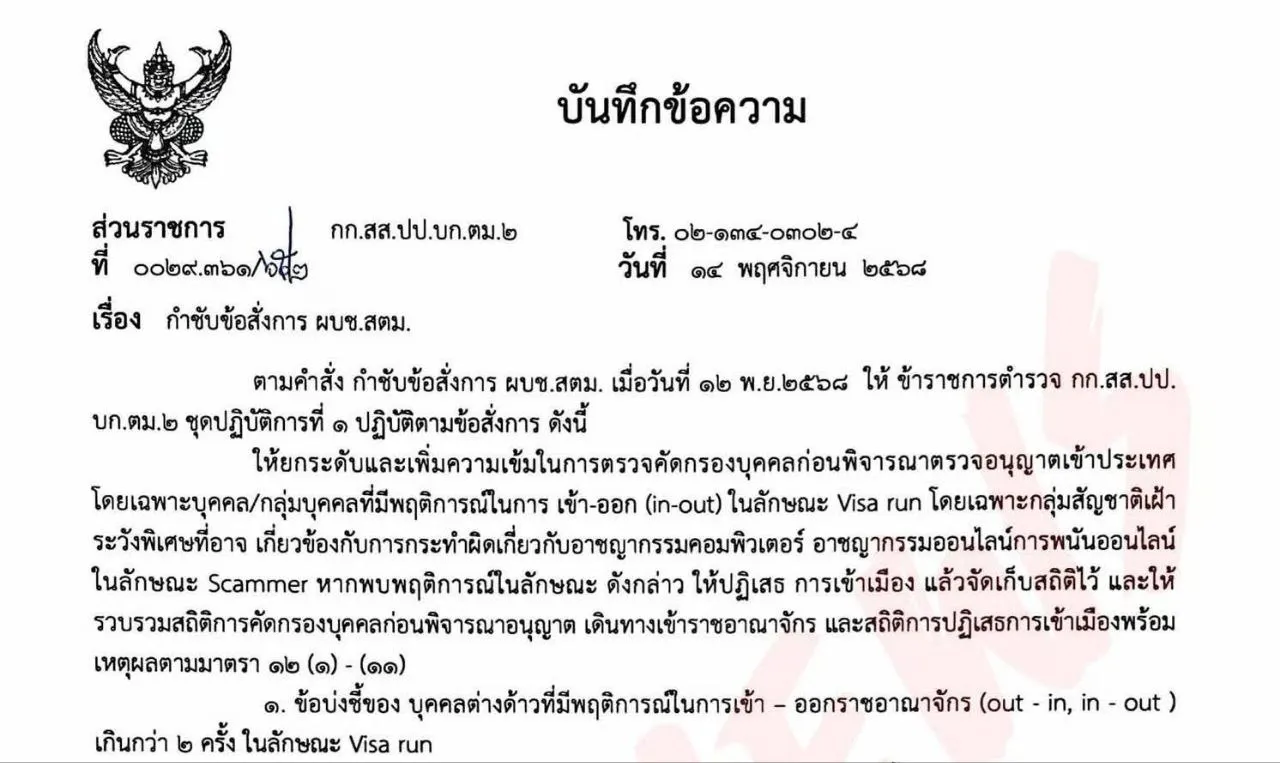
- “An official Ministry of Interior memo.” The document circulating under that name is an internal note from one immigration unit at Suvarnabhumi airport, dated 14 November and addressed to its own operations team. It restates the bureau commissioner’s order: run stricter checks on people making repeated visa runs, especially citizens of countries “under special watch” because of links to cyber fraud and online casinos, and keep statistics on refusals. It isn’t a nationwide rule, and it isn’t a Ministry of Interior document.
- “A second extension in a year is only 7 days”, “no extension after entering by land”. The bureau’s orders say nothing of the kind. Under the current order No. 12/2568, a tourist’s stay is extended once, by no more than 30 days, and that also applies to visa exemption under the agreement with Russia.
- “They give 7–15 days instead of 60.” There’s no such rule: the officer sets the period in the stamp, and the ceiling for visa exemption is now 30 days.
- “Fast track no longer guarantees entry.” It never did: it’s a paid queue, and the officer still decides whether you get in.
- Monthly reports to other countries’ ministries, TM-30 checks on hotels and “45 seconds to study your travel history” weren’t confirmed. The 45 seconds is the promised maximum time for a check, so that queues don’t grow.
What changed from 15 September 2026
The 60-day visa exemption has been scrapped. Citizens of 60 countries now enter visa-free for 30 days, and Russians, under a bilateral agreement, also for 30 days. Details, extensions and overstay fines are in our breakdown of the new visa exemption (in Russian).
Visa-free entry by land is allowed no more than twice per calendar year; entries by air don’t count. The exceptions are Malaysia, Brunei, Indonesia and Singapore. The rule is set out in the Ministry of Interior announcement on the list of visa-exempt countries. Whether it applies to Russians entering under the agreement hasn’t been officially clarified, so it’s safer to assume it does.
Since 1 May 2025, every entry, whether by air, land or sea, requires the TDAC electronic arrival card. It’s filled in free of charge at tdac.immigration.go.th, no earlier than three days before arrival.
If you live in Thailand long-term
Visa exemption no longer works as a way to live in the country: 30 days, one extension and close scrutiny of repeat entries.
- Tourist visa. Single entry, 60 days’ stay, $40 at the embassy in Moscow. You need paid return tickets, paid accommodation and a bank statement showing at least 20,000 baht per person. In Thailand it can be extended once, by another 30 days.
- DTV. A five-year visa with stays of up to 180 days per entry, each of which can be extended by another 180. For remote work, muay thai, cookery courses, medical treatment and family members; you need at least 500,000 baht in your account.
- Student (Non-ED), retirement, family, work: each has its own grounds and documents, and they’re arranged in advance.
At the border, keep your accommodation booking and a ticket out within your permitted stay to hand. TM-30, the residence notification, is filed separately, after you move in.