
In 2026 Thailand’s Department of Business Development (DBD) turned company registration for businesses with foreign shareholders into a way to screen out nominees. Since 1 January, the Thai shareholders of such companies have had to show bank statements. Since 1 August, the checks have covered the company’s whole life. As of June, 119,297 companies were in the risk group. By September, data on 36,277 companies holding land had gone to law enforcement agencies, and Chonburi, the province Pattaya is in, came first by number of such companies: 11,215. The market itself is stable: 60,198 companies were set up in January–August 2026, and foreigners invested 249 billion baht.
What the DBD is doing in 2026
A nominee is a Thai national who formally holds a stake or a post in a company but in fact acts for a foreigner, to get round the restrictions. A “mule” company is one used to move other people’s money and open accounts.
In January the DBD talked about a network of 17 agencies and its priorities for the year: 21,459 companies holding property, and 4,554 companies and individuals from the nominee risk group and the HR03 list of “mule accounts”. A package of “4 orders and 2 announcements” took effect on 1 January. Its main requirement: Thai shareholders in companies with foreign participation must submit three months of bank statements showing their contribution leaving the account.
By summer the rules had tightened. Since 1 April, the director has had to confirm at registration that all shareholders really did invest. Since 1 August, DBD Order 2/2569 has been in force: the checks cover the company’s whole life cycle, including changes of shareholders and directors, and statements are submitted by both the Thai investors and the recipient of the contribution. On 29 April the DBD signed a memorandum with as many as 23 agencies.
The DBD publishes results regularly:
- as of 21 June 2026, 119,297 companies with a foreign stake of 0.01% to 49.99% were in the risk group;
- new risk-group companies in January–May were down 65% on a year earlier, and in August there were 163 against 894 (−81.77%);
- data has been passed to the Revenue Department (14,800 companies), the Department of Lands (17,556), the police and the Department of Special Investigation (DSI);
- from October 2025 to June 2026, on-site inspections took place in 11 provinces, including Chonburi; in July the DBD named Chonburi, Rayong, Chiang Mai, Chiang Rai, Surat Thani, Phuket and Krabi as priorities.
The most telling figure concerns land. 36,277 companies with foreign participation hold about 1.06 million rai, and this data has been passed to law enforcement agencies. The leading province by number of such companies is Chonburi: 11,215, of which 9,706 have a foreign stake of up to 49%. The DBD’s director-general added a caveat, though: the data alone does not prove nominee ownership.
What this means for business owners
If a business is built on nominees and workarounds, the risk grows every month: the DBD has more data and more cross-checks with the Revenue Department, the Department of Lands and the banks. Chonburi province is in the spotlight for both land and on-site inspections. The data gives no separate figures for Pattaya.
If the business is legal and transparent, this is more of a plus: less competition from businesses working in the grey zone and clearer rules. But proper bookkeeping, real shareholder contributions and clear ownership are turning from formalities into protection. How registration works under the new rules is covered in the article on registering a company with foreign shareholders.
Business in numbers: 2026
According to the DBD report for August 2026:
- 60,198 companies were registered in January–August, 1.7% more than a year earlier; their registered capital was 181.7 billion baht, 6.5% less;
- 11,420 companies closed, 17.4% more than in the same period of 2025;
- 7,913 companies opened in August, most often in construction, restaurants and real estate;
- there are 1,014,836 active juristic persons on the register.
In January–August foreigners received 835 business permits under the Foreign Business Act (+22%) and invested 249.3 billion baht (+11%). For the first time China leads by number of projects (158); Singapore leads by value (73.4 billion), followed by Japan and China. The Eastern Economic Corridor (EEC) accounted for 260 projects and 96.9 billion baht.
2025 in review
In 2025, 85,251 new companies were registered, 2.7% fewer than in 2024, with registered capital of 264.2 billion baht (−7.5%). 22,783 companies closed (−3.8%). In December alone 5,187 companies opened and 6,112 closed: at the end of the year businesses traditionally wind up structures they no longer need.
Three sectors grew fastest over the year: other business services, with 1,168 new companies (+194%); hotels, resorts and serviced apartments, with 1,410 (+49%, while their capital rose 264% to 13 billion baht); and transport and logistics, with 1,961 (+30%).
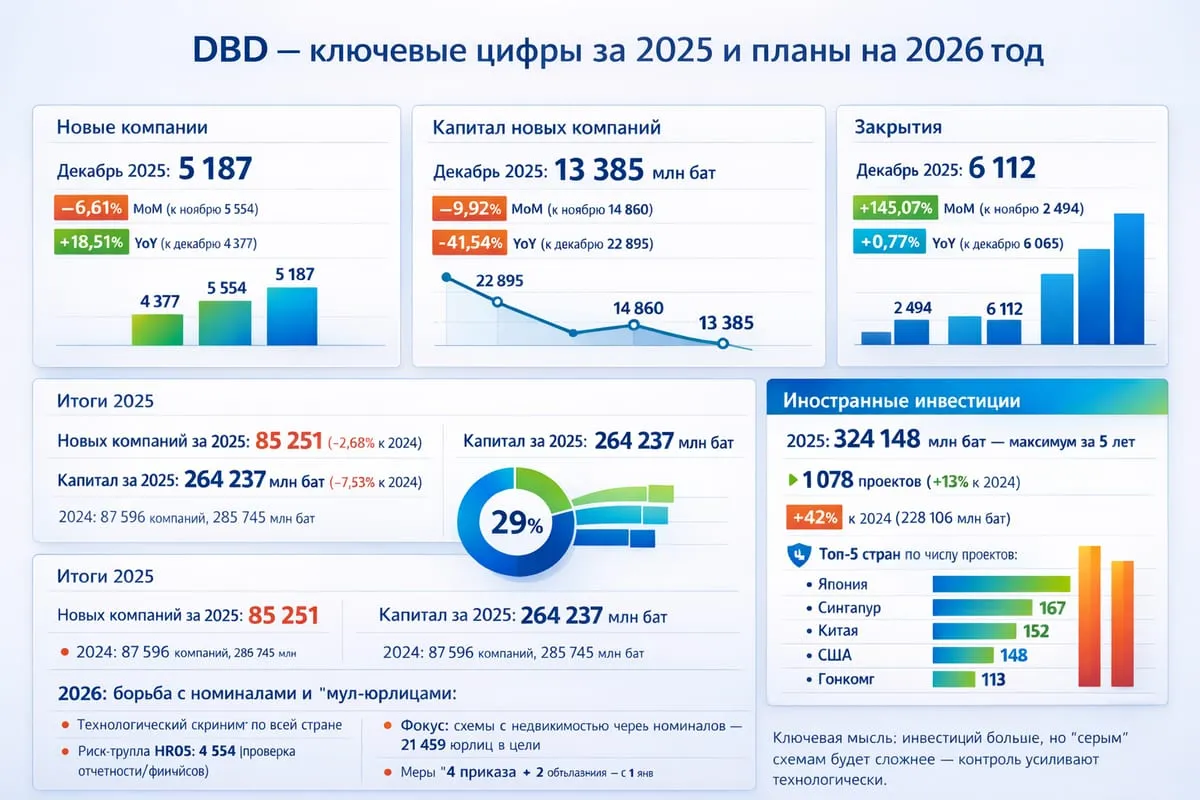
On 31 December 2025 there were 2,050,079 juristic persons on the register, of which 967,210 were active: limited companies (769,590), partnerships (196,115) and 1,505 public companies.
The headline figure of the year is foreign investment. Foreigners were granted 1,078 business permits with declared investment of 324.1 billion baht, the highest for 2021–2025: +13% by number and +42% by value on 2024. The top countries by number of projects were Japan (186), Singapore (167), China (152), the US (148) and Hong Kong (113). The EEC accounted for 313 projects and 106.5 billion baht.
The bottom line is simple: more money is coming into the economy, grey schemes are running out of room, and Chonburi is right at the centre of these checks.