
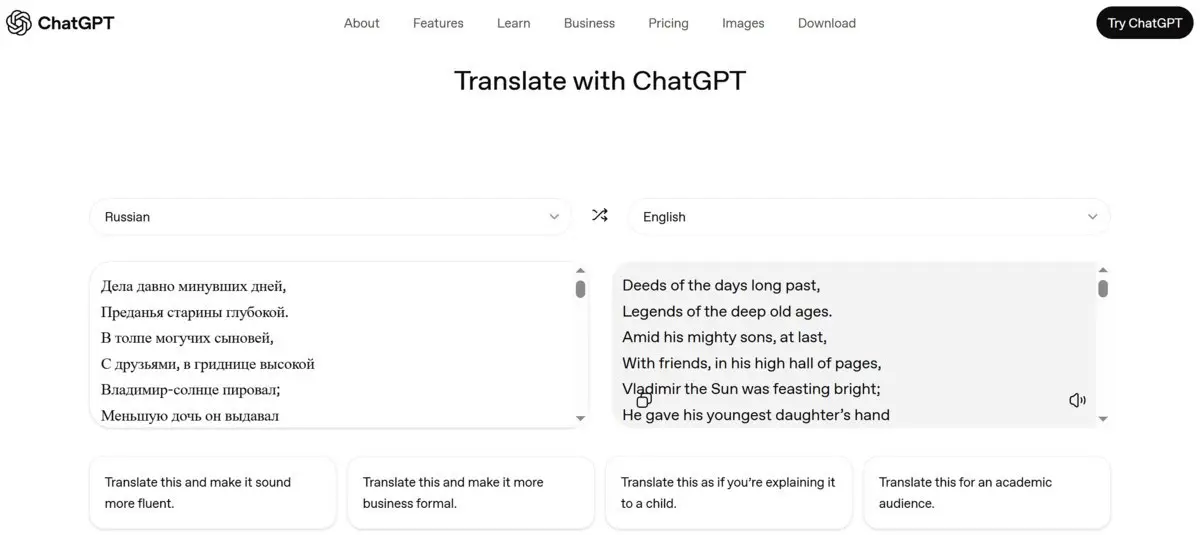
ChatGPT Translate is OpenAI’s standalone translator page at chatgpt.com/translate. It went live without an announcement on 14–15 January 2026: translation with automatic language detection, no sign-up, and buttons that rewrite the finished translation in a business, academic or plain style. By September 2026 the page had gained file uploads (including PDF, Word and PowerPoint) and dictation, and the drop-down list held 71 languages. The service still has no separate app and no API.
What it had at launch
OpenAI published neither a blog post nor a changelog entry: journalists found the service on their own. The page promised “50+ languages”, detected the source language by itself and worked without logging in.
The headline feature was the buttons under the translation: make it more fluent, make it business-formal, adapt it for an academic audience, or explain it “as if to a child”. In effect it was a translator and an editor in one window: translate an email, then make it politer or simpler straight away.
There were plenty of limitations. On a phone you could dictate text, but the promised photo translation did not work in any version at launch. The service did not translate documents such as PDFs.
What had changed by September
The page now accepts file uploads: images, text, PDF, DOCX and PPTX. Dictation has arrived on desktop, and there are now three style buttons after the translation: more fluent, professional and “explain it like I’m five”. OpenAI does not say whether the service keeps the document’s layout or returns only the translated text. The stated number of languages has oddly dropped to “40+”, even though the list now contains 71.
OpenAI’s live voice translation, meanwhile, lives not in Translate but in ChatGPT itself. In July 2026 the company released the GPT-Live voice models, which listen and speak at the same time and can translate a conversation on the fly. For developers, May 2026 brought the GPT-Realtime-Translate model: live speech translation from 70+ languages into 13, Russian included, at $0.034 a minute. ChatGPT Translate has no API of its own, just as it has no separate app.
Is it better than Google Translate or DeepL
There are no independent comparisons of this particular service. The most reliable reference point is WMT25, the academic machine translation competition held at the end of 2025: there the best language models beat classic online translators overall, but it compared models, not the ChatGPT Translate page. DeepL, for its part, says that in its own blind tests in June 2026 it beat GPT-5.5 in 15 of 18 language pairs and Google Translate in all 18. That is the company’s own claim.
The bottom line
ChatGPT Translate has stayed a quiet service: no announcements, no app and no API, but in eight months it has learnt to work with files and voice. For a quick translation with a change of tone (an email to a partner, an announcement, a message to a landlord) it is handier than the classic translators. Official documents and contracts still need a human, and for a live conversation ChatGPT’s voice mode is more convenient.
Where the rest of the line-up is heading is covered in the piece on merging ChatGPT and Codex into one app.