

Men and women differ in more than appearance. They differ in bodily experience, in the price of intimacy, in biological risk, in the logic of choosing a partner — and over time many psychological and social differences grow out of this.
At the root of it all is a simple fact: the female body is the one built to take on a pregnancy, carry a child and go through childbirth. The difference only looks minor at first glance. In reality it sets off a huge cascade of consequences that shapes relations between the sexes, mate-choice strategies, competition and the qualities society has attributed to men and women for centuries.
A woman carries a child for nine months, bears the physical strain and restrictions that come with pregnancy, then gives birth. After that, a strong bond between mother and child is almost inevitable — not only emotional but biochemical. The body literally nudges her towards attachment and care. That is why, on average, a sexual relationship carries higher stakes for a woman from the outset: its possible consequences are deeper, longer-lasting and harder on the body.
The high price of intimacy
Pregnancy is not an episode or a brief consequence of a casual decision. Even in the mildest case it means months of life governed by a new condition. In a broader sense it means years, and often the rest of her life, because a child does not vanish after birth but becomes part of her fate.
For a man, the price works differently. If he stays, he too enters a long story of responsibility, care and involvement. But biologically his contribution at the moment of conception can be limited to minutes. This is where a fundamental asymmetry is born: historically, the same sexual relationship did not mean the same thing for a man and for a woman.
If there is no strong bond between two people, a man can potentially leave almost at once. A woman, meanwhile, risks ending up in a situation that will demand months of pregnancy, childbirth, recovery and then long involvement in the child’s life. Even looking at it as dryly as possible, without romance or morality, the stakes are not comparable.
There is one more circumstance. A mother’s bond with her child is almost always physically and emotionally stronger, if only because the child develops inside her body and comes out of it. A man may not see the baby before birth, may doubt his paternity, keep his distance, disappear. A woman is denied that distance by definition. That is why, historically, a sexual decision was riskier for her and demanded greater selectivity.
A scarce resource
There is another reason why the female reproductive role becomes more “expensive” from an evolutionary point of view. In theory a man can father a huge number of children: his biology is not bound by nine months of pregnancy, childbirth and the recovery that follows. A woman’s is. Her body can carry only one pregnancy at a time, and pregnancy itself takes time, energy and a physiological toll.
Even if you count the extreme, almost fantastical maximums, the gap between male and female reproductive potential remains enormous. In theory a man can conceive orders of magnitude more children than a woman can bear. Hence a fundamental imbalance: male reproductive capacity is plentiful, female capacity is limited.
When one resource is more limited than another, it becomes more valuable in the logic of selection. That is why in many species females are choosier. If the cost of a mistake is high, you have to choose more carefully.
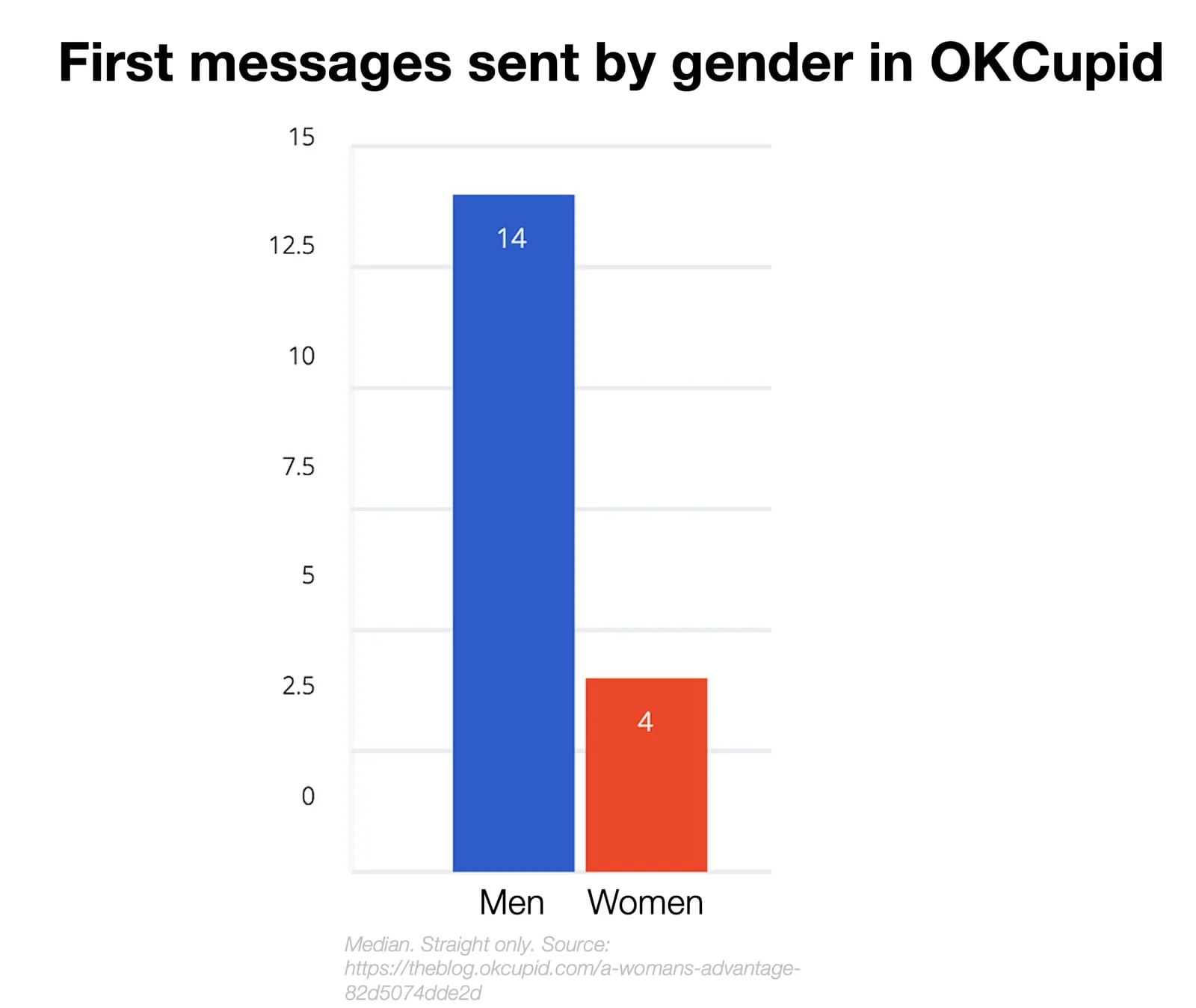
For a woman, a sexual relationship was historically not just a matter of desire but a decision with a high probability of serious consequences. For a man, the cost of a mistake was lower more often than not. A simple pattern grows out of this difference: men more often compete for access, women more often choose.
Why men start competing
If men are on average less limited in their reproductive opportunities, a sensible strategy for them is to seek as many mating opportunities as possible. But since women cannot respond at the same pace and in the same numbers, competition arises. Several men end up interested in the same woman, and then selection works not only through female choice but also through rivalry between men.
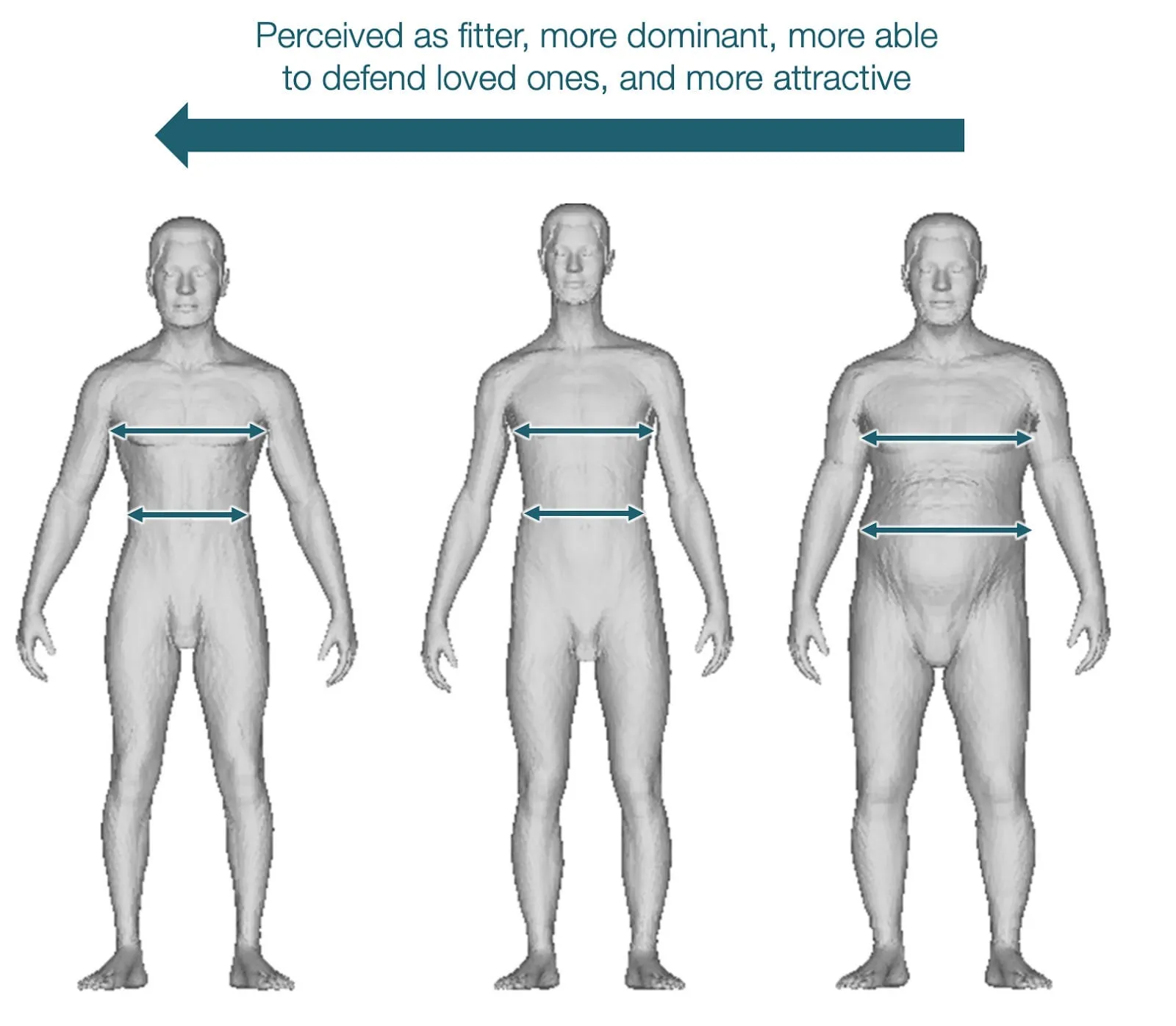
Men appear more attractive when they have a broader chest and a narrower waist.
Read the study: Why is low waist-to-chest ratio attractive in males? The mediating roles of perceived dominance, fitness, and protection ability.
This gives rise to a whole set of qualities that help beat competitors: physical strength, height, muscle mass, speed, stamina, decisiveness, aggression, a willingness to take risks, the ability to dominate and to come across as a dangerous rival.
Many physical differences between men and women can be seen through exactly this lens. Men are on average taller, stronger and heavier, especially in the upper body. They have more muscle mass, and that is precisely what gives them the edge in direct rivalry. Sturdier jaws, pronounced brow ridges, a more massive skull, greater resistance to strain — all of this can be read as traces of ancient intrasexual competition.
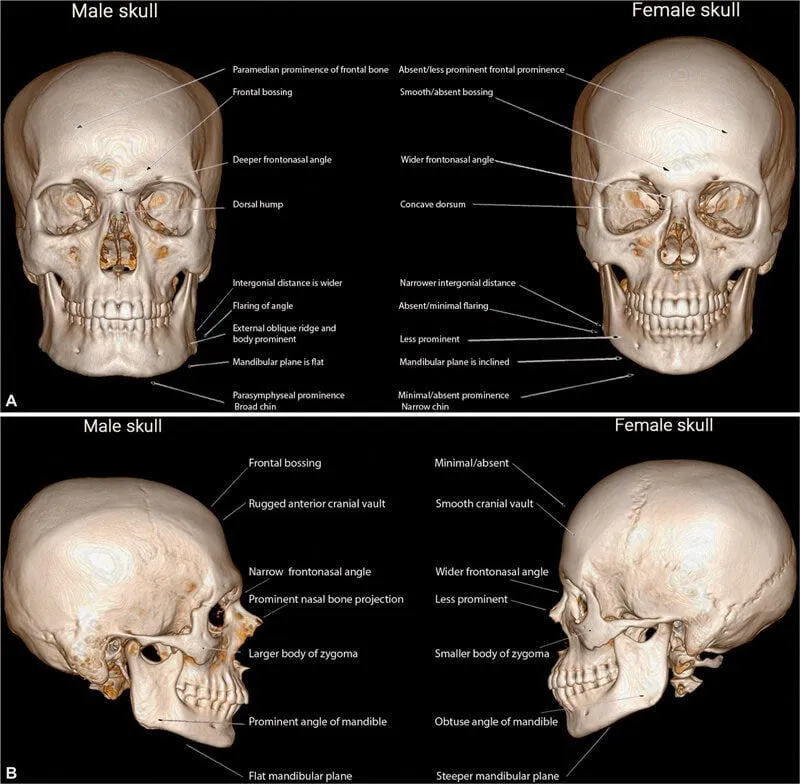
What matters here is not only real strength but showing it. A fight is not always won by the stronger one; often it goes to whoever looks more dangerous before the conflict even starts. That is why male attractiveness may historically have been amplified not only through useful qualities but also through traits that visually signal strength, status and dominance.
A beard is one such sign. In itself it does not make a man stronger, but it emphasises the jawline, adds hardness to the face and makes him look more formidable. Eyebrows, the shape of the face, the carriage of the head, the gaze, the voice all work in a similar way. This is the language of signals: before any action, the body tells others how dangerous or confident its owner is.
The language of male attractiveness
Look at this logic a little more closely and it becomes clear that many male qualities work not separately but as a single language of signals. Some speak of the ability to win, others of the ability to protect, still others of the ability to stay. And it is the combination of these qualities that forms the image of a man who could historically be seen as especially valuable.
In this system strength is not just a set of muscles but an ancient argument in the struggle for position. A man who looks physically composed, solid, able to take a blow and apply pressure carries a promise of superiority before he has done anything at all.
A broad chest, a narrow waist, a solid torso, a sense of physical stability — all this reads not as decorative beauty but as a sign of resources. Here is a person who is harder to break and more dangerous to underestimate.
But strength alone means nothing without stamina. A short burst can impress, but a long fight is won by whoever doesn’t run out of breath too early. So in this logic male attractiveness is tied not only to power but to a sense of reserve: the ability to withstand tension for a long time, stay in shape and keep control where others are already falling apart. This quality makes a man not only a dangerous rival but a reliable figure in real life.
From here grows dominance — not everyday rudeness or a crude habit of talking louder than everyone else, but a readable ability to take up space, stand tall and hold your own among other men. Dominance is socially visible strength. It shows in posture, in the gaze, in the way a man enters a room, in staying calm while others start to fuss. It is not necessarily a loud quality; sometimes, on the contrary, it shows as an almost icy composure.
Even aggressiveness in this system is understood not as a moral virtue but as an ancient tool for getting what you want. A readiness to clash, not to back down and to withstand open conflict could for centuries work as a competitive advantage. That is why some traits that today look like nothing more than a difficult temperament looked, in an older logic, like signs of a man able to hold his position and not give up what is his without a fight.
Physical details start speaking this language too. A strong jaw, a heavier face, pronounced brow ridges, a sturdy skull — all of this is perceived as an anatomy of resistance. Such a face seems harder, better able to take a hit, better suited to direct competition. And even if a modern person does not think about it literally, an ancient aesthetic may keep reading such traits as signals of strength.
A beard amplifies the effect. It does not make a man stronger by itself, but it makes his image heavier, sharper, more grown-up. It emphasises the jawline, adds shadow and visual density to the face, and creates a sense of greater danger and greater maturity. But that message is aimed at rivals rather than at women: in studies, a beard makes a man look older and higher in status, not more attractive. Eyebrows work in much the same way: they make the gaze harder and the face more focused, as if a readiness to apply pressure were already there.
A low voice continues the same theme, only at the level of sound. A deep timbre is rarely heard as neutral: it carries a sense of size, confidence, inner weight, an ability not to apologise for being there. Such a voice does not just convey information — it creates an impression of rank. That is why the voice turns out to be an important part of the male image: it can signal strength before a man has had the chance to prove anything.
Risk also takes on a special meaning in this system. A man who is ready to go where it is frightening and do what others won’t dare looks like a figure with higher inner stakes. It is a way of showing that here is a person for whom danger is not an insurmountable brake. But not all risk is equal. In studies, women favour men who take risks for others, while recklessness for the sake of a thrill tends to put them off: that kind of risk is more a signal to other men than to women.
But the image of an attractive man is not built on strength and risk alone. Intelligence matters just as much — the ability to understand the world, solve problems, see beyond the next clash. Strength wins the moment; intelligence wins the long run. A man who can find his way in a complex environment, make decisions, notice cause and effect and turn chaos into order looks not just strong but promising. Such a person can potentially not only win but build.
Creativity grows naturally out of intelligence — the ability to find unconventional solutions, invent something new, see what others walk past. In a world where you could not simply show wealth as a ready-made argument, subtler signs of resourcefulness were valued: quick wits, inventiveness, the ability to obtain things, to negotiate, to organise. Creativity in this sense is not an artistic ornament of personality but a form of effectiveness in life.
Humour holds a special place. Joking well is hard: it takes quick thinking, a feel for context, precision, lightness and self-confidence. Humour shows not only cheerfulness but cognitive strength. A man who can make people laugh shows that he commands attention, reads the situation and can create tension and manage it straight away. It is one of the most elegant ways to display intelligence without direct competition.
Status and money are the next step in the same series of signals. Status means a man has managed to accumulate something valuable: respect, influence, competence, access to resources. In the modern world money has become the visible form of this ability, but the logic itself is older than any currency. High status tells others: this person has already won a number of important games, so he has qualities that work neither by chance nor just once.
And yet what matters to a woman is not only a man who can win, but a man she can live with. That is why, in the long run, fidelity, reliability, warmth and the ability to invest, not to disappear and not to turn the relationship into an endless zone of tension become especially valuable. This is where brute strength stops being enough. Winning is not enough — you also have to be able to stay close in a way that lets someone build a life with you.
Even self-assurance, which in moderation can work as a signal of rank, is attractive only until it tips into empty self-admiration. Influence attracts, but what matters even more is what kind of person a man becomes once he has that influence. Ultimately, female choice in this logic proves more complex than a simple reaction to a bright outward signal: it balances between strength and safety, between superiority and fitness for intimacy, between impulse and the future.
This is how a coherent picture of male attractiveness takes shape: not just a strong male and not just a kind partner, but a figure that combines physical resources, social persuasiveness, intelligence, the ability to provide, the ability to protect and the ability to be there. Some qualities help a man win the competition, others spark desire, still others earn trust. Only together do they form the complex set of traits that, over the long run, could be seen as especially valuable.
How female choice works
But male competition alone does not explain everything. The other half of the picture is women’s preferences. If, given their limited reproductive capacity, it is women who more often do the choosing, then it is their choice that gradually fixes the qualities that turn out to be desirable.
And here an important effect appears: women may read the same traits that help a man beat other men. Height, strength, confidence, a low voice, physical composure, a sense of status — all of this becomes not only a weapon against rivals but also a signal of attractiveness. Beards and hard, masculine facial features are a different story: they certainly add menace and status, but whether women find them attractive depends on culture and setting. That preference is far from universal.
But the choice does not end there. What matters to a woman is not just a strong man but one who is reasonably likely to stay, protect her, provide resources and take part in raising the children. So attractiveness is made up of two large blocks: on one side, strength and signs of good genes; on the other, reliability, generosity, intelligence and the ability to invest.
That is why a man’s attractiveness never comes down to muscle alone. Intelligence matters, and a sense of humour, and social competence, and status, and the ability to be useful in a long life together.
Long-term and short-term choice
One of the most debated ideas in this logic is that women’s preferences may shift with context. For long-term relationships, warmth, fidelity, reliability, willingness to invest, intellectual maturity and the ability to be a good partner and father are especially important. For short-term attraction, other signals may come to the fore: striking physical attractiveness, dominance, confidence, strength, influence.
This does not mean there are two rigidly separate categories of men, or that human choice comes down to a biological scheme. It is more about different layers of motivation. Some qualities help spark desire, others trust, still others a sense of safety and a future. In real life all of this is intertwined.
It also matters that modern people live not on a primeval savannah but in a complex culture, where choosing a partner is shaped by upbringing, morality, personal experience, economics, trauma, values, social norms and conscious decisions. So evolutionary logic can explain a lot, but it does not account for the whole human being.
What follows from this
Put it all together and you get a fairly coherent picture. A difference in the cost of reproduction produces a difference in strategies. Where a woman risks more, she tends on average to be choosier. Where a man is less limited, he competes more often. Physical and behavioural traits grow out of that competition, and female choice fixes the qualities that turn out to be desirable.
This could explain why men show more muscle mass, physical strength, height, risk-taking, competitiveness, drive for status, and the urge to show off — through confidence, wit, humour and resources. Not because every man has to be like that, and not because every woman chooses the same way, but because over a long historical stretch it was precisely such mechanisms that selection may have rewarded more often.
Any explanation of this kind calls for caution, though. The difference between the sexes is real, but so is human complexity. Culture changes faster than biology, personality matters more than any scheme, and modern life has long since moved beyond simple reproductive logic. So such models are useful not as dogma but as a tool for understanding: they help show where some stable differences may have come from, but they give no right to reduce the whole human world to them.
Conclusion
Differences between men and women begin not in ideology or language but in how the body is built. A great deal grows out of this basic biological difference: a different cost of sexual choice, different selectivity, different competition, different signals of attractiveness, different behavioural strategies.
But precisely because the subject is deep and sensitive, it is worth approaching without overconfidence. It is easy to slide into oversimplification, moralising or pseudo-scientific certainty. It is far more useful to see it as a complex system, where biology lays the foundation and culture, personal experience and history build the rest.
The same conversation continues, this time about how we perceive beauty: what in attractiveness comes from evolution, and what from fashion.