
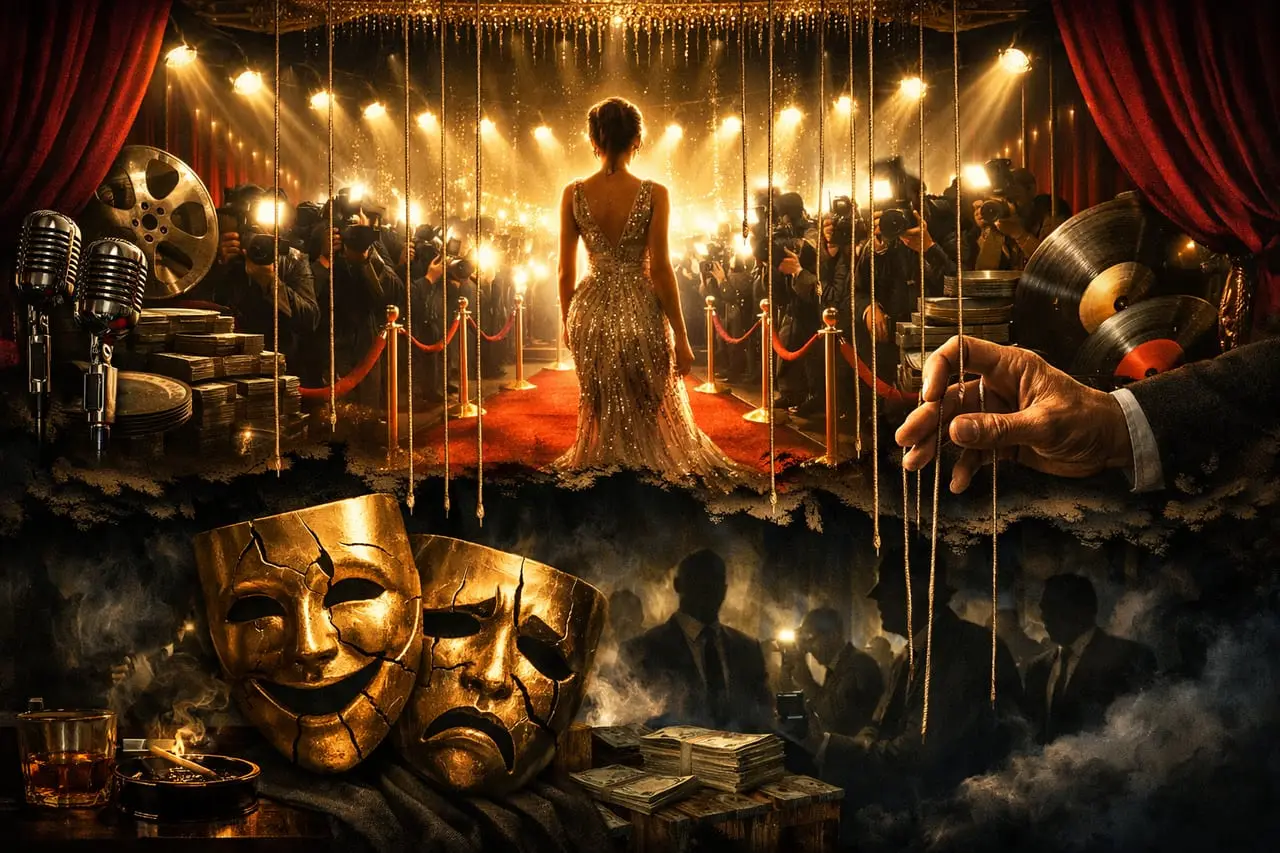
For far too long the entertainment industry lived by a dangerous rule: if someone is famous enough, talented enough and makes enough money, people are ready to forgive them almost anything.
While an artist fills venues, wins awards and shapes the culture, a special kind of leniency kicks in around them. Their actions are described not as a crime but as “the dark side of talent”, not as abuse of power but as “a complicated personal story”, not as a systemic problem but as yet another scandal that supposedly shouldn’t overshadow the legacy.
But strip away the industry’s familiar language and the picture gets much harsher.
This is not about random glitches or a few unpleasant episodes on the fringes of great art. It is about an environment that for decades let famous people use their status as a shield — and all too often stay in the spotlight even after the facts had become perfectly clear.
Fame as armour
The main problem here is not only the crimes themselves, but how status works.
When an ordinary person ends up at the centre of a grim story, society is quick to pass moral judgement. When the same thing happens to a star, a long chain of caveats begins. There is talk of the stature of the person, of the cultural contribution, of the need to “separate the artist from the art”, of the complexity of the era, of how you can’t reduce everything to a single episode.
In practice it means one thing: fame buys a moral head start.
The star gets time, room to manoeuvre, reputational shock absorbers and an army of people who will explain to the very end why now is not the time to tear down their image. That is exactly how the cult of celebrity turns into a defence mechanism.
Roman Polanski: when admitting guilt doesn’t destroy status
One of the most telling examples is Roman Polanski.
This is not a grey-area story or a clash of several murky versions. In 1977 Polanski pleaded guilty to unlawful sexual intercourse with a minor, then left the US before final sentencing and lived outside the country for decades.
You would think that would be enough for the industry to draw a hard moral line. The opposite happened.
Polanski did not disappear from the cultural canon. He was not promptly struck from the pantheon of great directors. On the contrary, he remained a recognised filmmaker, and in 2003 he won an Oscar for The Pianist. The Academy of Motion Picture Arts and Sciences expelled him only in 2018, forty years after he fled.
The very fact that a man with such a legal history kept his place at the top of the cultural hierarchy shows the main point: the industry knew how to live with this knowledge and did not consider it reason enough to break with him.
R. Kelly: how the system ignores the obvious for years
If the Polanski case shows the old model of industry forgiveness, the R. Kelly story shows its more modern form.
The singer was convicted in a federal case of racketeering and sexual exploitation. Prosecutors said plainly that for years he had used his fame, money and influence to dominate women and underage girls. He later received a further sentence in a case involving child pornography and the enticement of minors.
But what matters most here is not only the substance of the charges, but how long the system let this story drag on.
Scandals, rumours, public questions and warning signs followed his career for many years. And all that time the music machine kept running. The hits kept playing, the name kept its weight, and the industry behaved as if reputational damage didn’t matter much as long as the artist kept their commercial value.
This is one of the most cynical principles of show business: as long as the brand makes money, moral conclusions are put off.
Gary Glitter: when cultural memory resists reality
Another crystal-clear example is Gary Glitter.
He was once one of the prominent figures of British glam rock. Later his name came to be associated not with music, but with a series of child sex offences. In 2015 he was convicted in the UK of sexual assaults on girls.
In this story it is especially important to see not only the crime itself, but the inertia of the system.
Even when the facts have long since destroyed the old image, the cultural machine revises its view of someone who was once profitable, prominent and influential only slowly, and never completely. The industry’s memory is built to hold on to the old myth of a significant figure for as long as possible — even when that myth is already morally bankrupt.
Ian Watkins: the point beyond which no one can pretend
An extremely harsh but equally unambiguous case is Ian Watkins, the former frontman of Lostprophets.
In 2013 he pleaded guilty to multiple counts involving serious crimes against children and was given a long sentence. Here the usual machinery of cultural excuse-making barely gets going. The scale and nature of the crimes are so monstrous that the room for manoeuvre shrinks sharply.
Watkins did not live to finish his sentence: on 11 October 2025 he was killed at HMP Wakefield. Two fellow prisoners have been charged with his murder, and the case has not yet reached a verdict.
But even cases like this matter not only because of how grave they are.
They show the general logic of the system: fame does not create a criminal in itself, but it creates an environment in which a person enjoys trust, access and protection from awkward questions for longer — along with a sense of their own untouchability.
What these stories have in common
Polanski, R. Kelly, Gary Glitter and Ian Watkins come from different eras, different countries, different corners of the industry and different levels of public influence.
But their stories repeat the same structure.
At the top is a famous man with money, authority and a public image.
Around him are managers, agents, lawyers, producers, the media, a loyal audience and a shared fear of destroying a brand that brings in money and symbolic capital.
Below are the victims, who almost always find it harder to be heard, because they have to stand up not just to one particular person but to an entire system of interests.
That is why such stories cannot be explained only by the personal depravity of individuals. What we are looking at is not just a collection of private crimes. It is a mechanism in which status works as a way of postponing accountability.
The higher a figure stands in the hierarchy, the more cautiously, slowly and weakly the institutions around them react.
Why the industry protects its own for so long
Because the price of admitting the truth turns out to be too high.
Admitting the whole truth would mean destroying too much at once: the convenient myth of genius, a successful brand, a costly legacy, reputational investments, the audience’s sense of belonging, career connections and the cultural comfort of those used to admiring without awkward questions.
The entertainment industry as a whole works like a machine of denial. It knows how to pass off impunity as charisma, predation as a difficult character, exploitation as an occupational hazard, and systemic blindness as moral subtlety.
As long as these substitutions work, it always has a convenient way to change nothing.
The law isn’t everything
The conversation about impunity in the entertainment industry cannot be reduced to a question of law alone.
Yes, convictions and guilty pleas matter. But cultural complicity matters just as much. It is not only the offenders who keep the problem alive. It is kept alive by an environment that for years pretends talent can outweigh abuse of power.
It is kept alive by institutions that are too slow to react morally.
It is kept alive by a public that prefers not to know too much about the people whose films, songs and stage personas it enjoys admiring.
Why the old immunity has started to weaken
In recent years this immunity has started to weaken.
Not because the industry suddenly became more honest. And not because powerful people suddenly changed. The old monopoly on silence has simply gone.
Digital archives, investigations, open testimony, court documents and new norms of public conversation have made the old model of concealment less stable. What could once be dissolved in the legend of a great man now increasingly comes back as evidence of how far the industry was willing to go to cover for its own.
But it is important to understand: exposure alone is not enough.
The system does not collapse because of one article, one interview or one high-profile trial. It knows how to rebuild itself, change its vocabulary, put on a show of sensitivity and still keep its essence.
What matters most
What matters most is to stop pretending that these are rare exceptions.
In reality the industry lived for too long by a simple formula: if someone is famous enough, the system first protects their name, and only then other people’s safety.
Until this hierarchy is turned upside down, the problem will not stay in the past. It will simply find new faces, new genres, new platforms and a new language of self-justification.
That is why we need to talk about it plainly.
Not “scandalous episodes”, but abuse of power.
Not “the troubled lives of geniuses”, but real crimes and a long-standing culture of covering them up.
Not “a debate about legacy”, but the question of why the industry time and again tried to preserve a star’s greatness even where it should long ago have been protecting people rather than the myth.
Conclusion
If this topic has a truly honest conclusion, it is a simple one.
The problem was never only individual celebrities.
The problem was a system that for too long gave celebrities the sense that they were untouchable.
The loudest example of the same mechanism is 13,000 Epstein files and what was found in them (in Russian).