
A helmet saves your life. Gloves save your hands — from fractures, scars and complex operations, after which for many months you can’t even hold the handlebars properly.
In any crash, a rider’s first reflex is to put their hands out. And if the gloves are cheap fabric with no protection, the result is almost always the same: torn flesh, broken bones, stitches.
What matters in gloves
Sliders on the wrist and palm
This is the key feature that separates proper gear from “gloves from Tesco”. Sliders help you:
- avoid twisting your wrist in a fall
- avoid losing skin
- control how you slide
- avoid trying to brace yourself with your palm on the tarmac (the classic cause of fractures)
Essentially, they’re little “skis” on your hands. Without them, the risk of a serious injury in an ordinary fall goes up several times over.
Little finger bridged to the ring finger (Finger Bridge)
One of the most important but underrated details.
- the little finger is the most fragile finger
- it almost always gets twisted in a fall
- recovery is long and not always successful
Bridged fingers move as a unit and stop the little finger from “sliding off” to the side. Cheap gloves simply don’t have this.
Hard armour and knuckle protection
These take the main impact and spread the load. Without them, landing on your fist almost guarantees a fracture.
Materials: leather or dense reinforced textile
Tarmac burns through cheap faux leather in a fraction of a second. You need leather or textile with reinforcement.
Reinforced palm (double layer, Kevlar, SuperFabric)
The worst injuries happen when the palm gets “sliced” on the tarmac. Proper protection makes the palm practically indestructible.
A good example: Komine GK-215
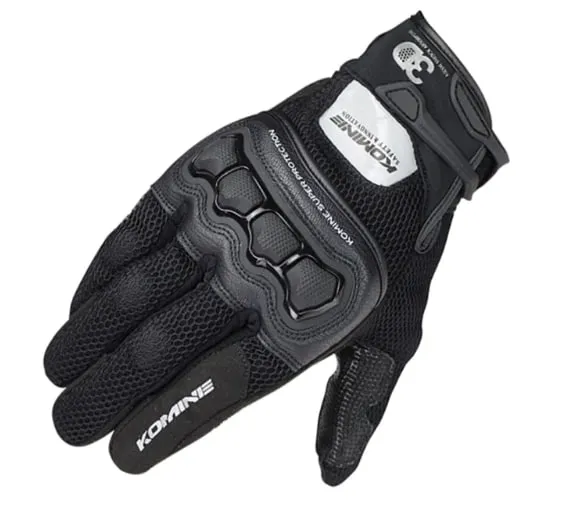
What you get:
- sliders
- hard armour
- a reinforced palm
- a bridged little finger (depending on the batch)
- leather and dense textile
- touchscreen compatibility
The model is sold on Lazada; check the price and availability there — they change.
Gloves without sliders and without bridged fingers aren’t worth considering at all.
Why you need gloves even for a trip “to the shop”
Most everyday crashes happen in car parks, on wet tiles and on corners taken at 20–30 km/h. And that’s exactly where people break their hands.
The bottom line
Only buy gloves that have:
- sliders
- hard armour
- a bridged little finger
- leather or reinforced textile
- a snug fit
Everything else is just “rags for your hands” that won’t save you when it counts.
Helmets get a separate guide: how to choose a good motorcycle helmet in Thailand.
If you don’t have a licence yet — how to get a Thai motorbike licence on your own.