Video: Transcript of a video interview from the Spectr Estate YouTube channel (in Russian).
Denis: Hi everyone. Today our guest is Anton. He lives in Thailand and he’s going to tell us how he moved here, what he does and how he’s built his life here. If you’ve got something to share too — your moving story, a business, what living in Thailand has been like — do get in touch.
Why Thailand and how the move happened
Denis: Anton, let’s start right at the beginning. Where are you from, and how did you even get to the idea of moving?
Anton: I’m from Moscow, born and bred, lived there my whole life. The idea of relocating didn’t come out of nowhere — I’d been thinking about it for a long time. It’s just that at some point the question got serious, and that’s when I started thinking about where exactly to go.
Thailand was one of the first places I looked at. I’d always liked the climate here, the atmosphere, that feeling of lightness. I’d been here before as a tourist, and the country really stuck with me. When it was time to decide, I knew this was where I wanted to be.
Pattaya happened pretty much by chance. At first I was looking at Bangkok, but some close friends of mine from Moscow had moved to Pattaya too, and at some point I thought: why not? So that’s how I ended up choosing this city.
Denis: Did you move on your own?
Anton: Back then I moved with my cat — we’ve been inseparable for years. After that, life here started to take shape around work, new people, then family and my own projects.
A career in marketing
Denis: Before Thailand you’d already been in marketing for a long time?
Anton: Yes. I’ve come quite a long way. I started out ages ago as a PPC specialist, worked at different agencies, built up experience, and then moved over to the client side and started doing marketing across the board.
Over time I worked my way up to head of marketing. I started building marketing teams from scratch, setting up digitalisation where a business didn’t have any, putting marketing on a data footing, building processes — and generally handling everything to do with promoting the company, mainly online but not only.
Denis: And that’s what you decided to keep doing in Thailand?
Anton: Yes. I’d been working remotely even before the move, so the format itself didn’t scare me. But just before I moved, something unpleasant happened: the company I worked for back then was in events, and during the pandemic that market basically stopped. They froze marketing and let me go.
I wasn’t too upset. I looked for work for about a month and found a new remote job — at an IT company from Novosibirsk. Part of the team had relocated to Pattaya, I met the guys in person here, and that’s how I started working with them.
Working at a crypto startup
Denis: What did that company do?
Anton: It was a startup in crypto analytics. The product was pretty niche — it was mainly for arbitrage traders and exchange services. The idea was that the system pulled data from several crypto exchanges at once, brought it all together in one place and let you update rates automatically. For a narrow professional audience it was a useful tool.
We promoted it precisely to those users. In Pattaya, by the way, quite a lot of people from that world were living here at the time. Plus, back then the Thai banking system was much more relaxed: accounts were easier to open, oversight was looser, and all of that made the country convenient for that kind of operation.
Then things changed: the regulator tightened control, the rules got stricter, and by then we’d basically already shown the product to everyone who needed it. We hit a ceiling: the audience was just too narrow. Management decided to put marketing on hold and think about how to rework the product for a wider audience.
By then I’d been living in Pattaya for more than a year and working on my own ideas on the side, so I took the pause calmly. I’d done the most I could for the project, and from there I started thinking about how to earn a living here on my own.
Where the idea for our own exchange service came from
Denis: And what happened next?
Anton: By then I already had my own Telegram chat, my own small community. Back then there were about 500–600 people in it. In Pattaya, Telegram is basically the main place where expats talk to each other: it’s where people meet, sort out everyday stuff, find people, services, events.
I was thinking about what to do next, and friends suggested an idea: set up my own currency exchange service (site in Russian). They said: you’ve already got an audience, people trust you, you’ve got bank accounts — why not give it a go? I really was lucky that I’d managed to open several Thai accounts back when it was easier. That helps a lot now.
Travelling and life before Thailand
Denis: Did you travel a lot before Thailand?
Anton: Yes, of course. I’d been to Thailand and Europe, and went to Greece, Spain, Turkey, Egypt — basically as an ordinary tourist. Back then I wasn’t thinking about relocating for good yet, I was just travelling for the experience.
If we’re talking about my first experience of a sort of “move”, that was Sochi when the pandemic began. I left Moscow for about a year to sit out the lockdown there.
Denis: And how was Sochi after Moscow?
Anton: Compared with Thailand, Thailand obviously suits me better. But Sochi is a decent option if you just want to spend the winter somewhere without going too far from what you’re used to. There’s the sea, mountains, a mild climate. But in terms of atmosphere and how life feels, Thailand is something else entirely.
The climate here is different, and so is the whole pace of life. Gradually you start to soak up the local vibe, you get calmer, you find that inner zen.
Visas and staying legal
Denis: Did you have any trouble with documents and visas?
Anton: At first it was all pretty simple: after I arrived I did a couple of border runs, then got a student visa. It was valid for a year. When it ran out, I had to do a few more trips out of the country, and then I got the digital nomad visa — the DTV.
That’s what I’m on now. When we recorded the interview, I’d already been using it for a few months and was just about to do my first visa run by plane.
Denis: A lot of people say that on this visa you don’t have to fly out, you can extend inside the country. Have you tried?
Anton: No, I haven’t tested it myself yet. My consultant advised me to fly out anyway: from an immigration point of view it looks cleaner. You can do a border run too, but a flight to another country is seen as less of a red flag.
And honestly, I later realised it’s actually good for you. When you stay in one place for a long time, it feels like everything’s fine and there’s no need to go anywhere, but changing the scenery every now and then really does matter. We flew to Vietnam, for example, and while I wouldn’t call it love at first sight, for a couple of weeks just for a change of scene it’s absolutely fine. Especially since you can combine the trip with a check-up and some errands.
If you compare the DTV with a student visa, the DTV is clearly better value and more convenient, especially in the long run. A student visa costs about the same, but it’s only valid for a year, you can’t fly in and out freely on it, and you also have to keep paying for extensions. Over the long haul the DTV makes a lot more sense.
Insurance, healthcare and accidents
Denis: What about insurance and healthcare in Thailand?
Anton: I never actually got proper local insurance. For the first few months I used the travel insurance I’d bought before flying out. That’s the usual story: through a bank subscription or similar services you can get basic travel insurance. But for people who’ve been living here for a long time it’s not really a workable option.
I wanted Thai insurance specifically — not international, but local and at a normal price. I dug around a bit and found a few companies that had supposedly offered insurance to foreigners on reasonable terms in the past. I went to their offices in Pattaya. One office only existed on the map. At the second, I was met by a very surprised employee who barely spoke any English. I tried to explain that I’d been living here a long time and wanted insurance for my family, I even showed them old receipts and sample plans. They wrote everything down, took my documents, then went quiet for a couple of days and in the end replied that they couldn’t help. No reason given.
So I put the question on hold. And luckily I haven’t seriously needed insurance so far, even though I have been in two motorbike accidents.
The first time, the bike fell on my leg, and it turned out I had a hairline fracture in my foot, no displacement. I didn’t realise it right away; the next day I went to the hospital, had an X-ray and they put a splint on. I paid for everything myself, because the people involved in the accident and I just went our separate ways on the spot: I was in shock and didn’t call the police, even though in fact it wasn’t my fault. Repairing the bike cost about 10,000 baht back then, and the medical side about another 8,000–10,000.
The second time I came off the bike out here, near Bang Saray, on a very slippery bridge. That time I got off lighter — I just went to Sattahip, to the military hospital. There the whole thing came to around 500 baht: an examination, cleaning up the wounds, no unnecessary drama.
After that I simply figured out where it makes sense to go for treatment. If you know the local system, you don’t have to go to expensive international hospitals. There are much cheaper and more relaxed options.
Why Bang Saray
Denis: Why did you end up choosing Bang Saray? I live here too and I like it myself, but I’m curious to hear your reasoning.
Anton: That was largely by chance too. When it became clear we needed more space — a house, kids, family — I started looking not just in Pattaya itself but further south, I looked at Jomtien, the south of the city, different neighbourhoods. And suddenly I saw a really good house in Bang Saray. From the photos I fell for it straight away.
The next morning I went to see it — and I genuinely liked everything. A separate village, quiet, lots of space, a good house and a sensible price. Yes, at first it seemed a bit far out, but the pluses outweighed it. I talked the family into moving, and then, once I started getting to know the area better, I liked it even more.
There really are a lot of advantages here: it’s quieter, calmer, less hustle, the city is only about fifteen minutes away, and nearby there are loads of places that work really well for family life. The kids love Nong Nooch, for one, there are water parks nearby, good beaches, nature reserves, plenty of places to walk.
Denis: How much do you pay for the house now?
Anton: Right now it’s 20,000 baht a month. Before that I paid 18. The floor area is over 100 square metres — about 120, actually. For Moscow, prices like that obviously sound unreal.
Denis: That’s the magic of Thailand: you’re by the sea, in a house, and it still doesn’t feel like a crazy amount.
Anton: Yes. Plus I’d just got a bit tired of living in Jomtien. The first year I enjoyed hanging out there, but then you keep bumping into the same people, endless bars, the same crowd. At some point I wanted some solitude — to be able to pop into town, get things done, go out — and then come back to a quiet place and my family.
How our own IT Party came about
Denis: But it’s in Pattaya that you’ve also built your own community. How did that even happen?
Anton: When I first moved here, I was missing people my own age and people on my wavelength. I was looking for people from the digital world — people you could talk shop with, swap experience with, just be normal friends with. I was living in a family condo, but I didn’t find my crowd there either. That’s how the idea of starting my own chat and my own community was born.
At first we got to know an existing local IT group that met on the beach on Fridays. I liked the concept: after the working week you meet up, have a beer, chat. I was delighted, brought a friend along and went to say hello.
But in real life it wasn’t what I’d expected. We came to the beach and saw a circle of people standing around discussing something very specialised. We said hello, but basically nobody brought us into the conversation. There was no sense that you were being let in. It was all very closed and pretty stuffy.
Then some other people came over — also new, younger. We got talking with them. Among them were designers, animators, people from a similar background, and with them the conversation just flowed. That’s how, bit by bit, a separate small group formed inside that big crowd.
Falling out with the old chat and starting a new community
Denis: And at what point did you decide you and that group were going different ways?
Anton: It happened gradually. First we saw toxicity in the chat towards newcomers. People could get annoyed that someone was loud, was drinking beer, whatever — even though the rules didn’t forbid any of it. At some point there were rows over trivial things.
And then it got personal. Back then I was working at the crypto startup and also running the company blog. I’ve got a lot of experience building not just SEO blogs, but engaging content projects that keep growing organically, without paid traffic. It wasn’t the first time I’d done something like that.
At some point my Thai bank account got frozen. I started digging deep into how it all works, why accounts get blocked, what the risk signs are, how to protect yourself. The team and I spent about a month collecting cases, asking people for their stories, getting answers from banks and the cyber police, and putting it all into a big, useful long read for expats.
When the article (in Russian) was ready, I decided to share it in that same IT chat. And that’s when a whole lot of negativity came pouring down on me. The accusations started, along the lines of: “You’re a marketer, you’re selling something, you want to steal data, you want traffic to your site, you’re promoting your company.” Even though the article was genuinely useful and didn’t directly sell the startup’s product.
That really got to me. People didn’t even read the thing properly, didn’t see the value, they just latched onto the domain it was published on. For me that said everything. I told them straight: with your stuffy atmosphere you’re killing a good idea. And in the heat of the moment I promised I’d build my own community and pull the audience over.
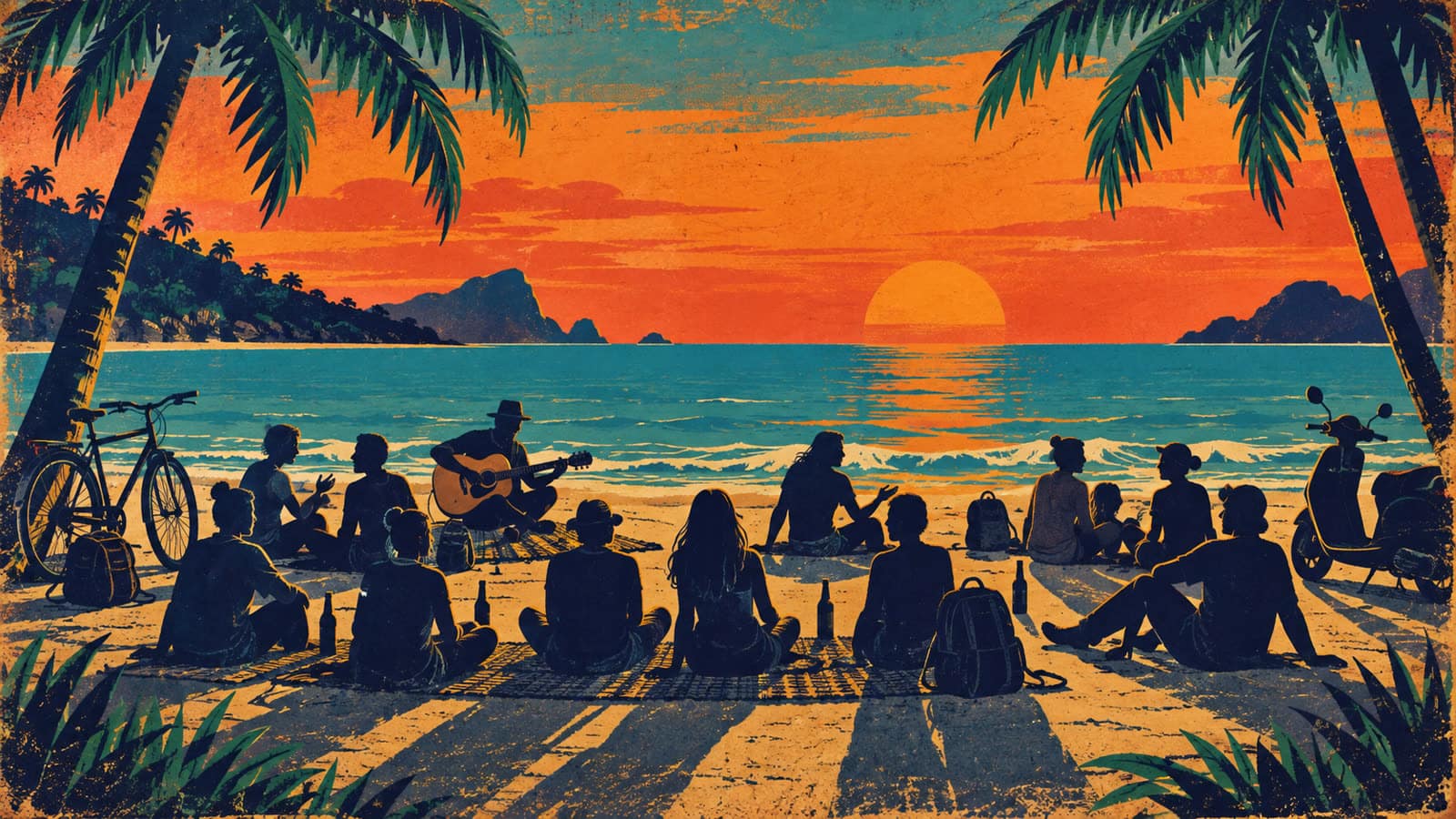
In a way, that’s what happened. The people I’d met at those first meetups and I joined forces, found a new spot, started our own chat, began inviting people and organising meetups. Word of mouth did its thing, musicians and guitarists turned up, and then a much wider expat crowd started gathering around it. Everything became much more alive, warmer and more natural.
We weren’t trying to make it snobbish or exclusive. If you want a beer, have a beer; if you just want to talk, talk; if you want to sing along to a guitar at sunset, go for it. The main thing is not to bother others and to be respectful. Apparently that’s exactly what struck a chord with a lot of people.
Is Thailand expensive to live in?
Denis: Let’s get to the most practical question. Is it expensive to live in Thailand?
Anton: It all depends on how well you understand the local market and how quickly you stop being a tourist. When you’ve just arrived, it’s easy to overpay for housing, bike rental and pretty much everything. A lot of people get burned on that. I did too at first — I rented a studio at an inflated price, and then it turned out a one-bedroom could have been had for less.
My mistake was that I rented my first flat through Russian estate agents. Later I found local contacts and started renting on better terms.
If we’re talking long-term rentals, you can find a studio for roughly 6,000 to 9,000 baht a month. A one-bedroom usually goes for 9,000 to 12,000–14,000 baht depending on the area, the furniture, the condition of the building and extra perks.
If you’re on your own, a studio can be quite enough. If you want more comfort, a one-bedroom is a really good option, and on a yearly contract the difference from a good studio often turns out to be pretty small.
Transport is much the same. You can find a small scooter for as little as 1,500–2,000 baht, but it’ll be an old one. Something newer is more like 2,500–3,500 baht. At first I rode a Honda PCX, paying about 2,500–3,000 for the rental, then I bought my own Honda Forza 300.
As for food, these days we mostly eat at home, but we go to cafés too. About 50/50. We shop at Makro, Lotus’s and similar hypermarkets.
If you’re single, you can get by on a thousand dollars a month. To live comfortably, more like fifteen hundred and up. For a family, I’d budget at least a thousand dollars per person, and better 1,200–1,500, so you can live calmly and not count every baht.
A Thai driving licence
Denis: Did you get a Thai driving licence here? Is it hard?
Anton: No, if you go yourself it’s perfectly doable. Although, of course, Thailand is full of “fixers” who can do everything for you — even to the point where someone prompts you with the answers remotely while you’re at the computer. But I wanted to go through it all myself.
I found a guide, got my documents together, chose a school, and in the end the school itself cost me about 1,000 baht. Getting the licence in total — about 1,555 baht.
Time-wise it took about three days, if nothing goes wrong. The medical certificate is quick. At the driving school, practice comes first, then theory. It’s all set up a bit differently from Russia.
The practical part isn’t hard, then they sit you at a computer to study the test questions, and the next day you take the theory test. The funniest thing is that you’re quite often expected to turn up at the driving school on your own bike, even though you don’t have a licence yet.
I didn’t have a Russian motorbike licence before that, just riding experience. And I didn’t pass the theory first time, by the way — only on my third attempt. But retakes are free there: you can try twice in one day, and if it doesn’t work out, you book again for a week later.
The main difficulty is the translation of the test questions. It’s better not to translate everything straight into Russian, but to use the English version first and look up the bits you don’t understand. Otherwise in Russian it sometimes comes out as a complete jumble.
What you do for a living now
Denis: And how do you support yourself and your family now?
Anton: My main income now is our IT OBMEN project (site in Russian). After I left the startup, friends suggested the idea, I found a partner among old acquaintances, and together we set up an online service exchanging roubles and crypto for baht.
I’m in charge of branding, marketing and promotion. My partner handles the operations, working with clients and the exchanges themselves. We’ve hardly spent anything on paid advertising: it mostly grew through my chat, through people we know and word of mouth.
Gradually we built up a base of regular clients. As the main community grew, the exchange service grew too. The income is seasonal, of course: in high season it’s noticeably higher, in low season lower. But even out of season the project can already properly support two families — mine and my partner’s.
Who your clients are and how it all works
Denis: Who’s your main audience?
Anton: Mostly Russian-speaking expats. The very people from the digital world, from my IT Party crowd — designers, IT people, remote workers, entrepreneurs. They trust us because we’ve been in this circle for a long time, we treat people decently and try to keep a good rate, without trying to squeeze profit out of a one-off deal at any cost.
Denis: And how do you hand over the money — only in person, or can it be done remotely?
Anton: Either way. One of the upsides of the Thai banking system is that many banks have a handy way to withdraw cash from an ATM with a QR code. So if someone already knows us and doesn’t need to meet in person, the whole thing can be done remotely.
But for the first exchanges we usually prefer to meet in person. People want to see real cash, to know they’re not being scammed. We show the cash, the person makes the transfer, and we hand over the amount right away, no waiting around. A lot of services make the client wait while they go off and finish exchanging something somewhere. We don’t like that approach.
We mostly exchange roubles sent by bank transfer and USDT for baht. Cash dollars and cash roubles don’t interest us, because the economics there are different and the rate is less favourable.
The grey zone, banks and getting legal
Denis: Is this actually legal? Taxes, licences, a company?
Anton: In Thailand it’s not that simple. Some parts of the business can be put on a legal footing, and that’s exactly what we’re working on. For example, you can get a licence for exchanging cash. But most of our operations are online exchanges, and Thailand doesn’t yet have a clear, complete legal framework for those. So this area is still in a grey zone.
At the same time, the state is generally moving towards legalising crypto and digital tools. Everything’s getting tighter for private individuals, but at the same time they’re trying to build an official route. Maybe over time there’ll be a single, clear mechanism where crypto wallets can be linked to Thai bank accounts more easily.
For now, though, the problem remains for a lot of winter visitors and tourists: even if a person can technically do a transaction on a Thai exchange, the question is — where do they then put the baht if they have no card, their account is frozen or they never managed to open one. That’s exactly where we come in.
As for the banks themselves, the rules have got much stricter. First it became hard to open accounts on just an entry stamp, then on student visas, then they started checking old accounts that people had opened through shady “helpers”. I was lucky on that front: I opened everything myself and in advance, so the harshest waves didn’t hit me.
But transactions still got blocked. For example, I’ve had situations where the bank froze a transfer for two weeks and the account went into the red in the meantime. And that’s exactly when having several accounts at different banks saves you. One account’s stuck — you use another.
What would you advise people who want to move?
Denis: What advice would you give people who want to move to Thailand but don’t yet know where to start?
Anton: First, don’t believe rumours and scare stories. Loads of people forward each other some frightening news — about diseases, natural disasters, all kinds of incredible dangers. It’s better to get the real picture from people who’ve lived here for a long time and kept their common sense.
Second, there’s no need to drag half your flat with you. You can buy everything you need here. It’s not the end of the earth. And whatever you can’t find in Pattaya you’ll most likely find in Bangkok, which is only an hour and a half away.
Third, it’s important to move not just “away from” something, but “for” something. You need either a job or a clear idea of what you’ll be doing here — remotely or locally. A move with nothing to lean on can quickly start to weigh on you psychologically.
And it’s also really important to look for your own circle as early as possible. When you move alone, there are tough stretches. Every expat has moments when everything feels hard: not much money, everything unfamiliar, no idea whether you did the right thing at all. At times like that, the only thing that saves you is a circle of like-minded people.
I always tell people: don’t be shy about coming to offline meetups, meeting people, joining the community.
I very often hear people say: “Shame we didn’t come sooner, we were scared for ages, we thought we’d be outsiders.” And then it turns out that this is exactly where they find friends, support and the feeling that they’re not alone.
Denis: Thank you so much for the conversation. It came out really lively, honest and useful.
Anton: Thank you. I hope my experience helps someone — with moving, with settling in, and just with not being afraid to start a new life.