Not long ago the generative graphics market looked like a race to see who could produce the most striking picture. Models learned to turn out photorealism and stylish illustrations for almost any prompt, but in real work it quickly became clear that one “pretty picture” doesn’t finish the job. As soon as a user writes a proper brief, with a composition, specific objects, text, recurring characters and a dozen small conditions, the magic turns into guesswork. The system forgets some of the requirements, mixes up the style, “swallows” elements of the scene or quietly breaks the idea at the level of composition.
That is exactly the pain Qwen-Image-2.0 is aimed at. It is Alibaba’s new model from the Qwen family, unveiled on 10 February 2026. In Alibaba’s framing, the step is less about “even prettier” and more about control: an image should come together like a layout built to instructions, not like a shot that happened to work out.
What has changed conceptually
The most important part of the release sounds almost mundane, but in practice it changes how the tool gets used: the model can work with instructions of up to 1,000 tokens. This is not just “you can write a long prompt”. It means a task can be phrased closer to the language of a designer or art director: what goes where, how the perspective works, which elements must be present, what light and materials to use, which details must stay unchanged.
The second claim is native 2K resolution (2048×2048). The logic here is simple: when a model generates a more detailed image “from the inside”, fine textures (fabric, skin, architectural surfaces, thin lines and interface elements) usually look more convincing than with upscaling, which often just magnifies the artefacts.
The third and perhaps most interesting part is an attempt to combine generation and editing in one approach. In typical pipelines these modes often live in separate models: one creates an image from scratch, another “makes edits” to an uploaded picture. The problems usually appear at the junction: style drift, loss of a character’s identity, strange “seams” where changes were made. Qwen-Image-2.0 is presented as a single engine for both creation and editing, with a promise of more natural transitions in light and colour.
Why everyone is suddenly talking about text inside images
If you look at how Alibaba presents the model, it becomes clear that typography plays a special role in the pitch. For the industry this is still one of the most painful areas. Models can produce an impressive scene, but lettering turns into a jumble of symbols and long text into mush.
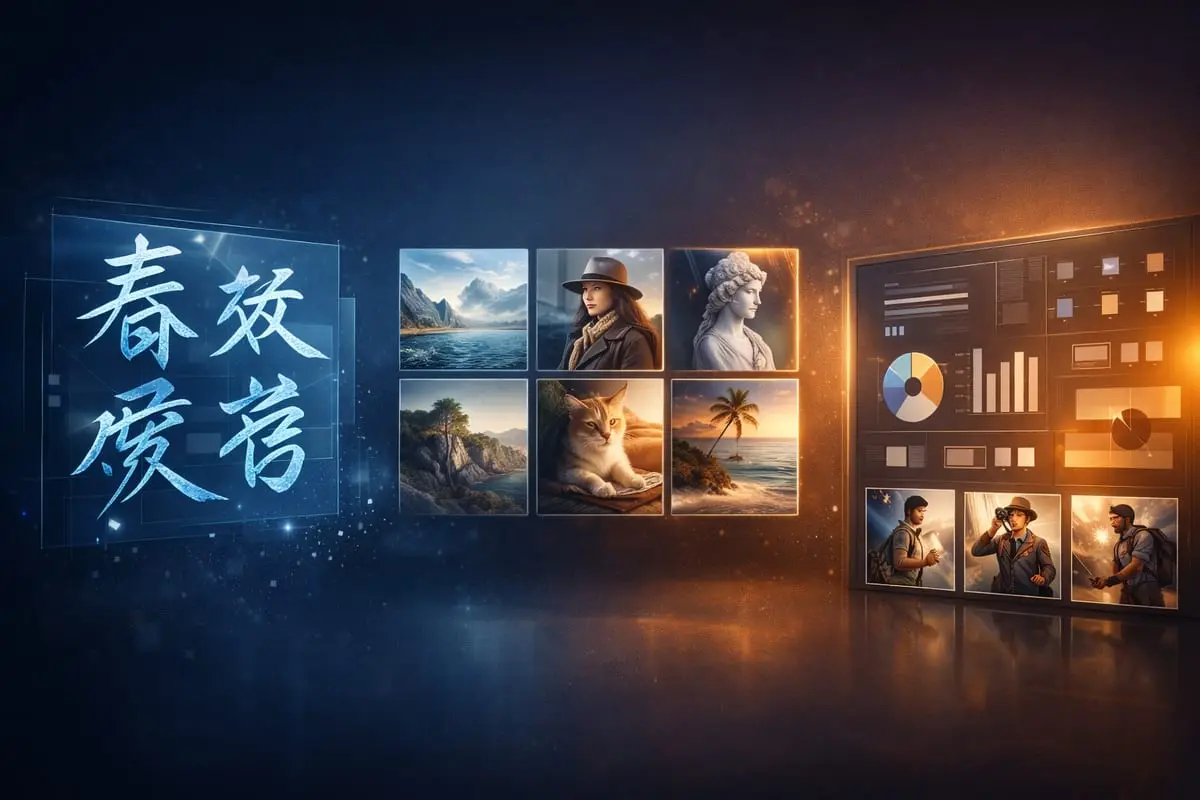
Qwen-Image-2.0 is positioned as a system that handles text noticeably better, including complex Chinese characters and calligraphy. This matters for more than “just Chinese”. Once a generator learns to hold text and layout reliably, it automatically becomes useful for practical work: posters, infographics, packaging, product cards and presentations. In other words, the model starts to be valued not for striking art but for its ability to produce half-finished material that is worth polishing into a final version.
Series and character “memory”: a quiet revolution for storytelling
Another class of tasks that long remained a dream is sequential images. Comics, storyboards and advertising series need stability: the same character has to stay recognisable from frame to frame. Most generators can produce “something similar”, but stability is something else: the same proportions, the same features, the same clothes and details that don’t drift with every new render.
The messaging around Qwen-Image-2.0 stresses exactly this aspect: the aim is to make the model fit for serial production of visual content, where repeatability matters. This is not a promise of “a comic at the push of a button”, but it is an important direction: less randomness where discipline is needed.
Comparisons with competitors: what to keep in mind
Alibaba cites the results of blind comparisons on its own platform and shows the model ranking high in both generation and editing. Any such ratings should be taken with caution: methods differ, and the platform belongs to the company itself.
But even with the caveats, the main point is visible: Qwen-Image-2.0 is being promoted as a universal “two in one” solution that should be strong at both creating and editing. In practice this matters more than individual showcase examples. In real work you almost always start with a draft, then edit, combine and refine, and this is exactly where most models lose quality.
Availability and the big question: will the model really go mainstream
The most sensitive point of any release like this is not quality but availability. At launch Qwen-Image-2.0 is shown through Qwen’s own interfaces and through cloud services, and API access may be limited. A separate question is public weights: if they become available to the community, an ecosystem of local pipelines, customisations and integrations quickly grows around the model. If not, the product settles in as a service geared to corporate tasks.
Why this release matters more than it seems
The most interesting thing about Qwen-Image-2.0 is not whether it “has learned to draw beautifully”. Plenty of models can do that today. What matters is something else: Alibaba is clearly trying to redefine the goal. Not inspiration and luck, but control and discipline. Long instructions, text, layout, series, editing without crude seams: these are signs that generators are gradually leaving the world of experiments and entering the world of production.
If the bet pays off, Qwen-Image-2.0 will compete not only with other models. Its rival will be the familiar workflow of “doing it by hand in an editor”. And that really is a new stage: when an image is not a lucky accident but a predictable result delivered to a brief.
The wider picture on models and releases is in the AI digest on LLM architectures and limits.