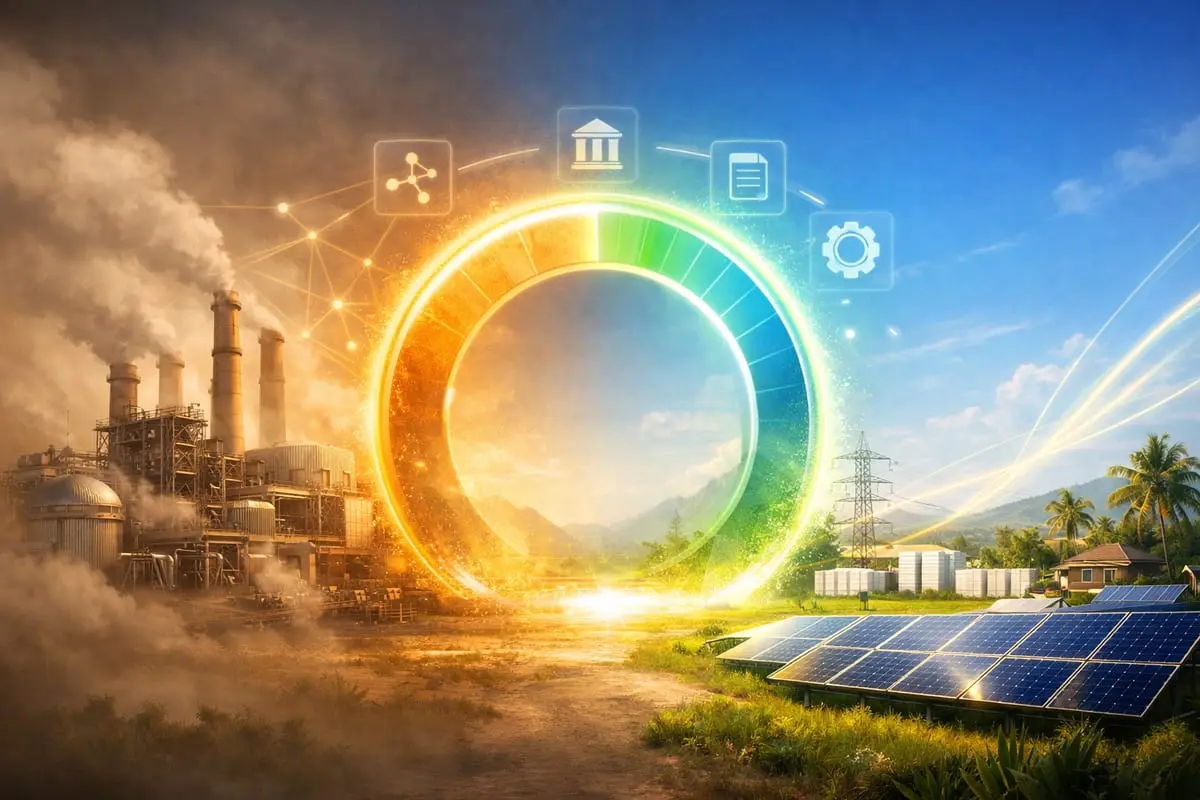
Thailand is often described as a country “between worlds”: it is already part of modern industry and regional supply chains, yet its energy sector still leans on familiar sources. Decarbonisation shows this especially clearly. The problem is not that there are “no solar panels” or “no technology”. The main difficulty is how the system is built: the rules, the grid, the money, the infrastructure.
Below is a look at what exactly is holding the transition back and what conclusions can be drawn.
Thailand’s starting point: gas and a very small share of solar
Natural gas plays the leading role in Thailand’s power sector, at around two thirds of generation. Solar still contributes little. In 2023, the year the World Bank report starts from, solar generation supplied around 3% of output (2.8% in the report), and by 2025, according to Ember’s estimate, about 5%.
This detail matters: when solar’s share is that small, it cannot yet change the system as a whole. Gas generation easily “outweighs” it, while the infrastructure and the market carry on the old way.
Why “just bring in a carbon tax” doesn’t solve it
Many people assume that if emissions are made expensive (through a carbon tax or a similar mechanism), companies will switch to clean energy on their own. In practice this works, but not always in the same way.
The World Bank’s model shows an important effect for Thailand:
- the same instrument (a carbon tax) can produce very different results depending on how developed solar energy already is;
- with the same tax, solar’s share reaches roughly 16% by 2050 if it starts from 2.8%, and 67% if it is first raised to 25%;
- if the tax is introduced once solar already supplies around 15% (roughly the level of China and Vietnam), it cuts emissions more at any rate.
Put simply: when there is little solar, the tax gives no “push”. Once solar already makes up a meaningful share, the tax becomes a powerful incentive, because the system finds it easier to switch.
What “the system isn’t ready” means
Buying panels is not enough for solar to grow fast. It takes conditions that let projects appear at scale.
Money and loans
Solar plants and projects depend heavily on the interest rate at which money is lent and on how confident banks are that the rules won’t change tomorrow. If financing is expensive, solar becomes less profitable, even when the technology itself is already cheap.
The grid
Solar generation is not simply “install it and it runs”. It has to be connected, the system has to be balanced, sometimes the grid needs reinforcing, sometimes storage has to be added. If the grid and the connection rules aren’t ready, growth hits a ceiling.
Coordination
Many players are involved: developers, power companies, regulators, banks, local authorities, permitting procedures. If these parts don’t work in step, projects stall, timelines stretch and costs rise.
That is why, while solar supplies only a few per cent of output, the system may “not feel” even a strong economic signal.
How Thailand approaches carbon regulation: pilots first, then a law
Thailand is not standing still. The country has long been discussing and testing carbon regulation mechanisms:
- the Thailand Greenhouse Gas Management Organization (TGO) launched a voluntary emissions trading system (ETS) back in 2013: essentially a test version of the system and a proving ground for emissions accounting;
- the pilot covers 12 carbon-intensive sectors;
- the base years for the calculations are 2012–2013;
- both direct and indirect emissions are counted;
- since 2016 the government has also been weighing other ways of pricing carbon;
- in 2021 the pilot was extended to the Eastern Economic Corridor (EEC), a key industrial area.
It looks like a training run before the big launch: the country is setting up rules for emissions accounting, testing the processes and training the participants.
Binding rules have followed. On 21 January 2025 the cabinet approved the first carbon tax, at 200 baht per tonne of CO2 equivalent. It is built into the excise duty on fuel: petrol, diesel, kerosene, jet fuel, liquefied gas and fuel oil. Retail prices do not change as a result.
On 2 December 2025 the cabinet approved in principle a draft Climate Change Act. It provides for mandatory emissions trading (with 2029 as the target start), a carbon tax and a carbon border levy on imports. As of autumn 2026 the Council of State is reviewing the draft clause by clause, it has not yet gone to parliament, and adoption is expected in the third quarter of 2027.
What follows from this: two stages instead of “one big decision”
Put it all together and a clear logic emerges.
Stage 1: lift solar’s share to “critical mass”
In 2023 solar supplied 2.8% of output, and by 2025 about 5%. At this level the main thing is not to expect miracles from a tax but to remove what is blocking growth:
- make the rules for projects clear and stable;
- speed up connections and procedures;
- prepare the grid for a larger volume of solar generation;
- help the market with financing (so that projects are easier to lend to).
The goal is to get out of the “very little” zone.
Stage 2: with solar at around 15%, the tax works harder
If the tax is introduced once solar already supplies around 15%, it cuts emissions more at any rate: solar generation is already built into the system, and an extra incentive turns into real projects and lower emissions more quickly.
The effect is stronger still in the scenario where solar’s share is raised to 25% before the tax: by 2050 it then reaches 67%.
In short
- Thailand’s power system rests on gas, while solar contributes little: 2.8% in 2023 according to the World Bank report and about 5% in 2025 by Ember’s estimate.
- In the report’s model, the same carbon tax lifts solar’s share by 2050 to roughly 16% from the 2023 starting point, and to 67% if it is first brought up to 25%.
- A tax introduced once solar already supplies around 15% cuts emissions more at any rate.
- Thailand has moved towards carbon regulation through testing: a voluntary ETS since 2013, 12 sectors, a 2012–2013 base, extension to the EEC in 2021. Since 2025 a tax of 200 baht per tonne of CO2 has been part of the fuel excise, and a Climate Change Act with mandatory emissions trading is expected in 2027.
The main idea is simple: Thailand’s decarbonisation is not about “buying panels”, it is about “getting the system ready”. Once the system is ready, even a single economic lever starts changing everything faster.
How much energy the digital side of this transition will need: the data centres approved by the BOI.