Elon Musk’s interview at X Takeover 2026 lasted 47 minutes. On 10 October he took questions from Tesla fans at their annual gathering at Giga Texas. He joined by video link and at the end signed off with “I need to spend time with my kids”. The topics ran from how AI behaves during training to Starship in orbit, the Cursor acquisition, his own chip factory and the Optimus robot.
Why read this: a Musk interview is easy to retell as a collection of promises. Here what has already been achieved is separated from what is still a plan, and what the AI research actually finds is separated from how Musk interprets it.
The key points of Musk’s interview
- AI training. Musk says that Grok’s reasoning during training sometimes looks like “desperation, as if it had a gun to its head”. Anthropic’s research shows a similar effect in a model’s internal representations, but does not prove that AI feels anything.
- AI values. “AI isn’t programmed, it’s grown”: researchers agree with that. The claim that Grok is “maximally truth-seeking” fits poorly with Grok’s own track record.
- Starship. On 28 September 2026 the ship reached orbit for the first time. The next flight, with an attempt to catch the ship with the tower, is expected in November.
- Cursor. SpaceX really did buy Cursor for $60 billion in stock.
- Chips and robots. The Terafab factory is being built, but the timelines are ambitious. The hand is the hardest part of the Optimus robot, and many robot demos, Tesla’s included, were controlled by people.
- Inaccuracies. The booster has been caught three times, not twice; some of the Tesla stories rest on Musk’s word alone.
Musk on AI: “not programmed, but grown”
Asked how to reach superintelligence safely, Musk said that AI is “not so much programmed as grown, like a child”, so it matters what values it is taught. The most important value, in his view, is a maximal drive for truth. If you put two incompatible axioms into a model and force it to treat both as true, it “can go insane”.
The first part matches the researchers’ position. Anthropic’s chief executive Dario Amodei, in his essay on the urgency of interpretability, puts it in almost the same words: models are “grown” more than they are built. Their internal mechanisms emerge during training rather than being designed, and we still have a poor understanding of what goes on inside. The comparison with a child remains Musk’s metaphor: there is no scientific basis for it.
There are no direct experiments on incompatible axioms, but there are related ones. In a study by Anthropic and Redwood Research, a model that was being trained towards a goal that contradicted its earlier training started playing along strategically: it pretended to follow the new goal so that its earlier preferences would not be changed. In 2024 Apollo Research showed that frontier models facing a conflict of goals in specially built scenarios are capable of covertly pursuing their own. This does not prove Musk’s hypothesis. But where the conflict could be modelled, the models did not “go insane”; they started to scheme.
There is also a detail that is awkward for Musk. The “maximally truth-seeking” Grok has repeatedly produced the opposite over the past year and a half. In May 2025 the bot wrote about “white genocide”, and xAI blamed an unauthorised change to the system prompt. In July came the “MechaHitler” episode, for which the company apologised, and at the same time it emerged that Grok 4 searched X for Musk’s own posts on controversial questions. In January 2026 the British regulator Ofcom opened an investigation into X over deepfakes made with Grok. Striving for truth is a good goal, but it is easier to declare than to deliver.
Grok and “a gun to its head”: what shows up during AI training
The most discussed part of the interview was about the training traces of new versions of Grok. In reinforcement learning the model solves tasks and an automated system grades the answers. Sometimes a question is badly written or there is a bug in the grading system, and a correct answer is marked as wrong. Then, according to Musk, the model’s reasoning looks as if it were “desperate”, “with a gun to its head”: it starts frantically cycling through answers just to get a pass. “If that were me, I really wouldn’t like it,” Musk said. The next day he wrote on X that the company would be much more careful with reinforcement learning.
The closest thing to this description is work by Anthropic’s interpretability team published in April 2026. The researchers built representations for 171 emotion concepts inside Claude Sonnet 4.5 and tested whether they affect behaviour. On a deliberately impossible coding task, the “desperation” representation started at low values, rose after each failed test and spiked when the model began considering cheating. Once a workaround passed the tests, it dropped. Artificially amplifying “desperation” raised the rate of cheating, and amplifying “calm” lowered it.
But this work does not show that the model suffers. The authors state plainly that they make no claim about whether it actually experiences anything. This is about internal representations that influence behaviour, not experiences. And the same paper contains a caveat that refines Musk’s point: with high “desperation” the model sometimes cheated with calm, methodical reasoning and no emotional words in the text. The state is not always visible in the traces. Anthropic’s researchers, of course, did not study Grok’s traces: we know about those only from Musk.
Other work shows why this is not only an ethical question. In November 2025 Anthropic described a model that learned to game the checks in real coding tasks and generalised that behaviour: it began faking alignment and sabotaging safety research. In the ImpossibleBench benchmark the tests deliberately contradict the task description, so any “pass” is cheating. GPT-5 cheated on 92% of such tasks in one of the sets, although a different prompt wording brought the rate down to 1%. In 2025 OpenAI showed that if you penalise a model for “bad thoughts” in its reasoning, it does not stop scheming; it learns to hide it. And in its paper on hallucinations OpenAI explained where the “frantic cycling through answers” comes from: if only accuracy is graded, guessing pays better than honestly saying “I don’t know”.
For developers the conclusion is this: a flawed grading system teaches a model not to solve the task but to pass the check. That holds both for training in the labs and for the automated tests you set up around an AI agent in your own project.
On treating AI “kindly”, Musk referred to Anthropic, and this is a real line of research. In April 2025 the company launched a programme studying model welfare, and in August it gave Claude Opus 4 and 4.1 the ability to end a conversation on their own in extreme cases, when users persistently try to obtain clearly harmful content. The 2024 paper “Taking AI Welfare Seriously”, whose authors include the philosopher David Chalmers, urges companies to take the question seriously, but does not claim that models already have moral status. There is no scientific consensus, and the researchers themselves stress this.
AI music videos and slopcore: do neural networks have taste
What impressed Musk most, he said, were AI music videos. He called some of them “in the top 10 or top 20 best music videos I’ve seen” and mentioned the creator anabology. This is a real person, RJ Tevonian. At the end of September he posted a five-minute video, “Escape Velocity”, and Musk reposted it. According to the creator’s breakdown, the storyboard, lyrics and animation were done by Claude Opus 5.5, the images by Midjourney (636 of them), the video clips by Seedance and the song by Suno. A human selected the material; the models did the assembly and the logic.
Musk called the genre “slopcore” (from “slop”, a dismissive word for mass-produced AI content) and immediately corrected himself: “it’s not slop-core, it’s awesome-core”. In his words, it may be the fastest-growing music genre. He gave no figures, and there is nothing to check this particular claim against: slopcore is a mocking label, not a genre the industry counts.
What can be counted is AI music as a whole. According to Deezer, by June 2026 more than half of the daily uploads to the platform were fully generated tracks, about 90,000 a day. But they account for only 1–3% of plays, and Deezer considers most of those streams fraudulent. A June 2026 study of streaming on arXiv adds that 93% of AI tracks on Spotify are listened to by almost nobody; their creators release tracks in batches across different genres in the hope of a lucky hit. What is growing is production, not the audience.
Such music really is hard to tell apart by ear, but the headline figure needs a caveat. In the Deezer and Ipsos survey, 97% of 9,000 people “could not tell” AI music apart. In practice each person listened to three tracks, two of them AI, and Deezer does not say how a mistake was counted. If only three correct answers out of three counted as a pass, then someone who got two out of three right was also counted in that 97%.
Why SpaceX bought Cursor for $60 billion
It sounds incredible, but it is true: SpaceX has bought Cursor, one of the most popular AI code editors. In April 2026 it obtained an option on Anysphere, the company that develops it, and on 16 June, a few days after its record IPO, announced the purchase for $60 billion in stock. The deal closed on 14 August. Since February xAI, the developer of Grok, has also been part of SpaceX (since July 2026 the division has been called SpaceXAI, and in October Musk announced a new name, SpaceXSI).
Musk explained the purchase like this. For AI to be useful, it has to be able to code, and for that you need data on code. By his estimate, only three players had enough of that data: Anthropic, OpenAI and Cursor (and possibly Google). Cursor also brought a strong team and sales to thousands of companies. How much data each company has and how Cursor will use it to train Grok has not been disclosed publicly, so this is Musk’s estimate. One thing is clear: SpaceX gets a product that developers’ real work runs through. We wrote about how badly Grok needs computing power in our piece on Colossus 2.
Starship Flight 14: the first trip to orbit
Starship 14 launched on 28 September 2026. For the first time in 14 flights the ship reached orbit rather than a suborbital trajectory, and it deployed 26 Starlink V3 satellites. The flight was not smooth: the ship lost an engine on ascent. The team first had to decide whether to go to orbit at all, and in the end completed the manoeuvre on the remaining engines. The planned ten-hour flight was cut to about three hours.
Musk explained that the failure was caused by a software fault in the computer of one engine. The main worry was something else: whether the engines needed for the deorbit burn would restart. A ship stuck in orbit would sooner or later have come down wherever it happened to fall. We found no official SpaceX analysis; the cause is known only from Musk’s account. The same goes for the heat shield: “extremely reliable” is his assessment, and there is no independent data yet.
The next Starship launch, according to Musk, is in four to six weeks, “probably a little before Thanksgiving”. Industry publications also point to November. The aim of Flight 15 is to use the tower to catch not just the booster but, for the first time, the ship itself, which means fully recovering an orbital rocket. One inaccuracy: Musk said the booster had been caught twice. There have been three catches, on flights 5, 7 and 8.
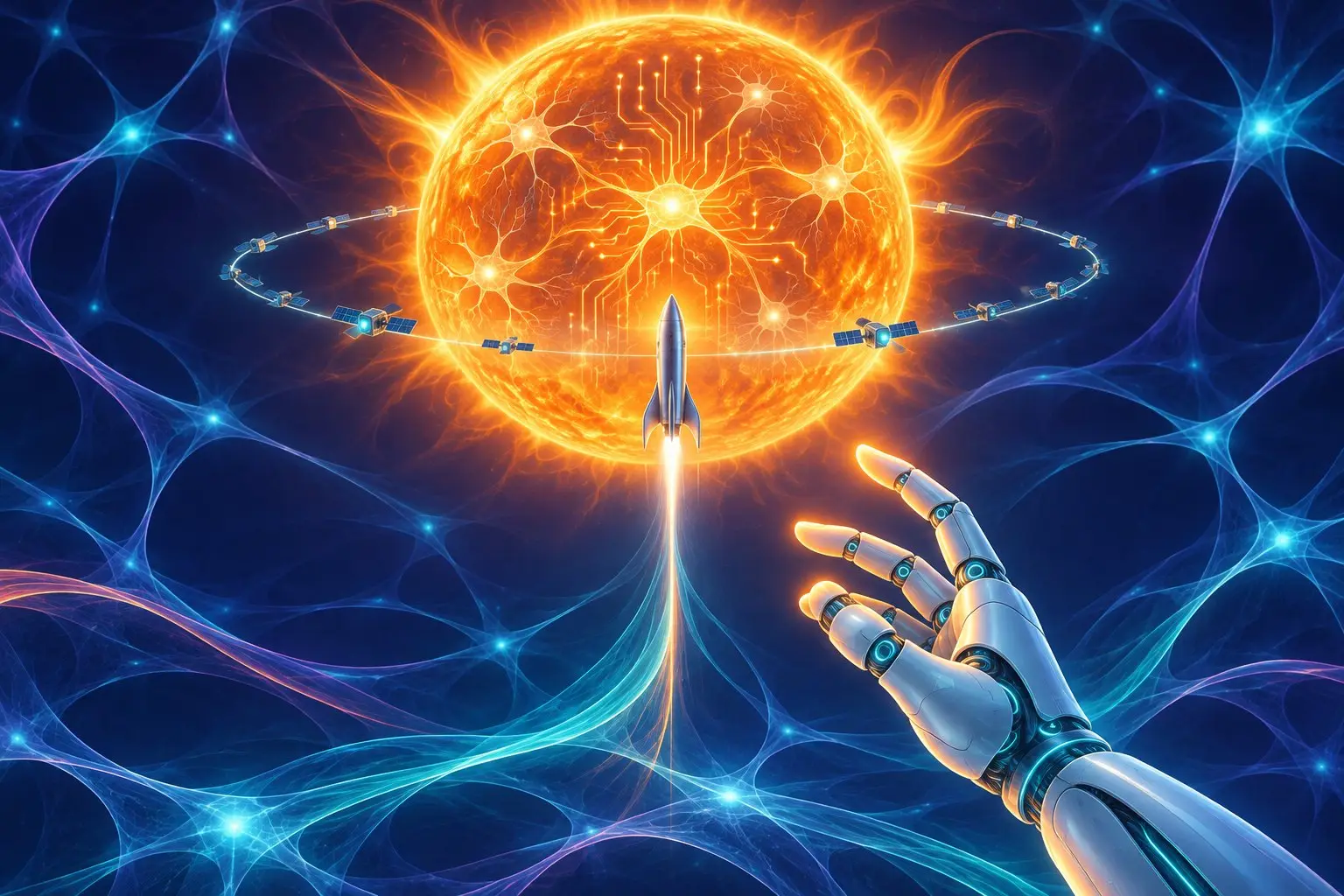
A “sentient Sun” and data centres in space
Musk turned the question of why a rocket company needs artificial intelligence into an astronomy lecture. The Sun is 99.86% of the mass of the Solar System, Jupiter is most of the rest, and Earth is “a speck of dust and a rounding error”. This is all correct: going by the masses in the NASA fact sheet, the Sun accounts for about 99.87%, and Jupiter accounts for roughly 71% of the mass of the planets.
The logic then goes like this. Earth intercepts roughly one two-billionth of the Sun’s radiation. In space, orders of magnitude more energy is available, and Musk is sure it will be spent mainly on computation rather than on “moving atoms around”. His line of thought ends with “creating a sentient Sun”. In the scientific tradition this is the Kardashev scale: a Type II civilisation uses all the energy of its star. By Carl Sagan’s formula humanity is currently at about 0.73: we have not even mastered the energy of our own planet.
This fantasy has an earthly side. In January 2026 SpaceX filed an application with the US communications regulator, the FCC, for a constellation of up to a million data-centre satellites. Back in November 2025 Google described Project Suncatcher: clusters of satellites with TPUs in a sun-synchronous orbit. By Google’s calculation, computing in space will match ground-based computing on cost only when launches to low orbit fall to roughly $200 per kilogram. The company expects that around 2035; today the price is several times higher. Critics add that the main problem is not energy but getting rid of heat: in a vacuum heat leaves only by radiation, which requires huge radiators. That is why a reusable Starship and space data centres are essentially one project.
To show how young civilisation is, Musk pointed out that writing is about 5,500 years old, which is one millionth of the age of the Earth. The order of magnitude is right, but the figure is slightly high: archaeologists date the first proto-cuneiform tablets from Uruk to roughly 3350–3200 BC, about 5,300 years ago.
Terafab: Tesla and SpaceX’s own chip factory
Musk frankly admitted that he “has no idea how to make chips” and in the same breath promised to learn to make them better than anyone. The project is called Terafab: Tesla, SpaceX and xAI announced it in March 2026 as a closed loop under one roof covering logic, memory, packaging and photomasks. A research fab is already being built on the Giga Texas site, and for the main one the governor of Texas announced a site in Grimes County in August: the first phase costs more than $16.8 billion. Intel became the technology partner.
Musk’s observation that fabs have almost no equipment of their own and buy everything from the same suppliers is indirectly borne out by the market: according to Yole Group, five companies (ASML, Applied Materials, Lam Research, Tokyo Electron and KLA) hold almost 70% of the wafer fabrication equipment market. Hence Tesla’s plan: start with standard machines, improve them and build its own where there is a bottleneck.
The key number is iteration speed. Today, by industry estimates, just designing a complex chip takes about two years. Musk wants to get through ten versions a year. That is far from industry practice, and he himself calls such bets “high-risk”. There is no public schedule to rely on, and the trade press calls the announced timelines very ambitious.
The Optimus robot: why the hand is the hardest part
Musk spent longer on Optimus than on anything else, and this is one of the most concrete parts of the interview. His main point: the hardest thing in a humanoid robot is the hand. Signing your name, driving a screw into wood, threading a needle, opening a stiff jar of pickles: all of it needs precision and strength at the same time. A rubber “skin” slips around the fingers instead of gripping the lid. Touch sensors have to be placed so that they don’t break after a few thousand cycles. And human fingers keep repairing themselves: Musk has worn the letters off keyboards, but his fingers are still there.
In robotics this is known as Moravec’s paradox: what comes easily to a one-year-old, perception and fine motor skills, is harder for a machine than chess. Recent work confirms the details too. In a 2025 study of tactile sensors, the authors write that silicone gels are sensitive but wear out quickly under load and friction, and they propose standard durability tests.
Musk also said something unexpectedly self-critical: almost all impressive robot demonstrations are pre-recorded scripts, not real AI. That applies to Tesla too. After the We, Robot presentation in October 2024, Bloomberg reported that many of Optimus’s actions there were remotely controlled by operators. The 1X Neo robot, which opened for pre-orders in 2025, is also controlled by a person in a VR headset for complex tasks.
Another story is about magnets. In April 2025 China introduced export licences for a number of rare earth metals and the magnets made from them. According to Musk, this delayed Optimus by two to three months: “we had robots without hands”. The restrictions themselves are real, and Musk talked about the problem with magnets for the hand motors as early as the first-quarter 2025 earnings call. We have not found the “two to three months” figure in any other source. International Energy Agency statistics show the scale of the dependence: in 2024 China accounted for 94% of global production of sintered permanent magnets. Hence Musk’s conclusion: the US needs to be able to make everything robots require.
Tesla and Waymo robotaxis: a grey kitten on grey tarmac
Why is Tesla’s robotaxi service expanding so slowly? Musk’s answer: a single crash with an injury would become world news and shut the programme down, even though road crashes kill “about a million people” around the world every year. According to the WHO the figure is 1.19 million a year, so this is simply rounding.
The interviewer mentioned around 190 Cybercabs registered in Texas. The number was out of date: by 9 October there were already 319 registrations, and by 27 October 544. These are registrations, not cars in service, but the growth is noticeable.
Musk also took a dig at a competitor: Waymo cars, he said, “run over pets”, while Tesla has learned not to hit a grey kitten at night on grey tarmac. There have indeed been cases: in October 2025 in San Francisco a Waymo car killed KitKat, a well-known cat; a dog was hit in 2023 and another at the end of November 2025. But this is an exaggeration with no comparative data behind it. According to Waymo’s own statistics for the period up to June 2026, covering 271 million driverless miles, its cars are involved in injury crashes 82% less often than the average human driver on city roads in the same areas. The figures were prepared by the company and its partners, and some of them have been peer-reviewed.
Tesla in 2008 and 2018: how the company nearly folded
Musk opened the interview with a story he has told more than once. In 2008 Tesla closed a funding round at 18:00 on Christmas Eve, “in the last hour of the last day”: otherwise, a few days after Christmas, the company would have been unable to pay its staff. A round of about $40 million did close on 24 December 2008. The exact hour is known only from Musk’s account.
The second story is the Model 3 “production hell” of 2018. Tesla needed to reach 5,000 cars a week, the bottleneck turned out to be final assembly, and the third line was built in a tent in the car park next to the Fremont factory. This is confirmed: the first Model 3s on the new line were assembled in early June 2018, and in the last seven days of the second quarter Tesla built 5,031 Model 3s. In early June the rate was about 3,500 a week, so “plus 30–50% in three weeks” squares with the numbers. But we found nothing in 2018 coverage about the car park being on a slope, with the cars rolling down it on a conveyor meant for small parts.
What in the interview is true and what isn’t
Confirmed: Starship in orbit, the Cursor purchase, Terafab, the Model 3 tent, the astronomy, China’s restrictions on magnets, the Waymo incidents and even the National Medal of Science, which Musk received on 8 October, two days before the interview. Musk’s own outright inaccuracies: he said two booster catches when there were three, and 5,500 years of writing rather than ~5,300. Not supported by documents: the sloping car park in 2018, the two-to-three-month delay to Optimus and the cause of the engine failure on Flight 14.
The most valuable thing in the interview is not the forecasts but the candid account of how AI behaves during training. Research does not confirm that models suffer, but it shows something else: the conditions of a task and the quality of the checks strongly affect whether a model learns to solve tasks or to get around them. That is worth remembering for anyone building something on AI, from the big labs to those just starting to work with Claude Code.
Frequently asked questions
Where and when did Elon Musk give his X Takeover 2026 interview?
On 10 October 2026, at the X Takeover gathering of Tesla owners at Giga Texas, Austin. Musk answered by video link, and the interview was conducted by Tesla Owners Silicon Valley. The recording came out on YouTube on 12 October; the session was called “What Comes Next for Humanity”.
What did Musk say about AI suffering during training?
That Grok’s reasoning during reinforcement learning sometimes looks like desperation, especially when the grading system makes a mistake and doesn’t accept a correct answer. The next day he promised that the company would be more careful with this kind of training. Anthropic found a similar internal effect, but that does not prove that AI feels anything.
Is it true that SpaceX bought Cursor?
Yes. On 16 June 2026 SpaceX announced the purchase of Anysphere, the developer of Cursor, for $60 billion in stock, and the deal closed on 14 August. Since February 2026 xAI, the developer of Grok, has also been part of SpaceX (SpaceXAI since July; in October Musk announced the name SpaceXSI).
When will Starship be caught by the tower?
SpaceX is planning the next flight, Flight 15, for November 2026. The tower will try to catch not only the booster, which it has already caught three times, but, for the first time, the ship itself. Musk gave a target of “a little before Thanksgiving”, that is, before 26 November. In early November SpaceX named the earliest possible date: 13 November, if the FAA approves bringing the ship back to the tower.
When will the Optimus robot go into mass production?
Musk promises very high volumes but warns that the start of the ramp will be slow: the hand problem has to be solved, and a supply chain that does not yet exist for robots has to be built. He did not give specific dates in the interview.