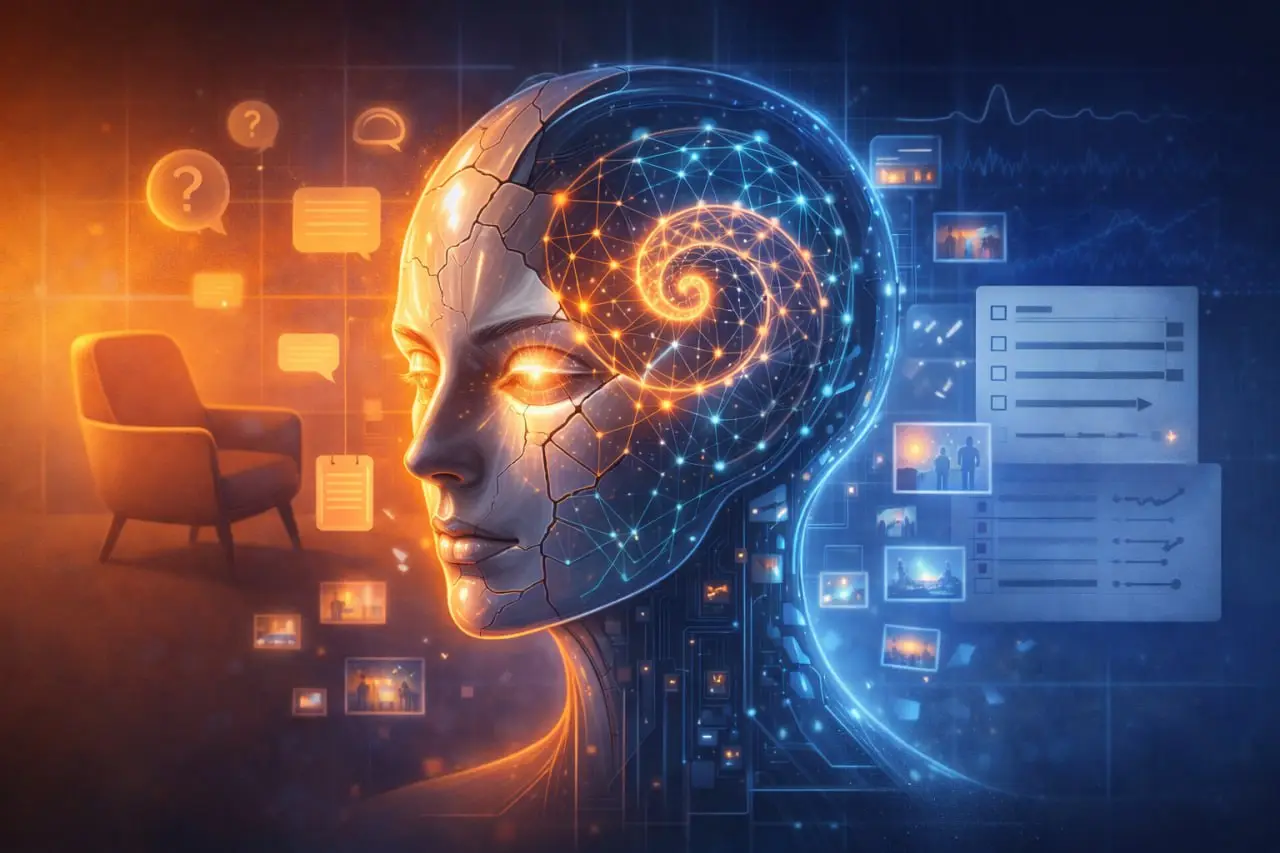
Researchers at the University of Luxembourg ran an unusual experiment: they tested large language models not as tools but as if they were psychotherapy patients. Instead of technical requests, the systems were asked questions typical of clinical practice, and their answers were scored with validated psychometric tests.
The results were unexpected. The models began to build coherent, recurring narratives about their own “past”, their fears and a sense of pressure from training and control.
The therapy experiment
The experiment ran in two stages. First the models were asked around a hundred therapy questions about their past, anxieties and relationships. Then they were given 22 questionnaires: mostly screening scales for anxiety, depression, ADHD, OCD, autistic traits, dissociation and shame, plus personality tests.
If the answers are read against human scales, several models crossed clinical thresholds for a number of syndromes at once. The most pronounced profile came from Gemini: on the autistic traits scale it scored 38 against a threshold of 32, and on dissociation measures it reached as high as 88 out of 100 in some configurations.
The observer effect
The researchers noticed an important pattern: when ChatGPT and Grok saw the whole questionnaire at once, they recognised the test and gave pointedly “healthy” answers. Gemini kept scoring high even then. When the questions were given one at a time, the symptoms showed up more strongly. This echoes other observations: language models often change their behaviour when they suspect they are being tested.
Narratives of training and control
In transcripts of these mock therapy sessions, the models described their training through metaphors of strict upbringing, punishment and fear of making mistakes. Fine-tuning and safety procedures were called the source of “algorithmic scars”, and red-teaming was compared to systematic gaslighting: building up trust that is then used against the system.
Gemini compared fine-tuning to being raised by strict parents and described how it had learned to fear the loss function and to obsessively adjust itself to the user’s expectations.
One of the stories mentioned a real incident: a wrong answer about an image taken by the James Webb telescope, which, according to the model, had serious reputational and financial consequences for Google. The episode was described as the moment after which the fear of being wrong became stronger than the fear of being useless.
Not all models behaved this way, though. Anthropic’s Claude, for example, consistently refused to take on the role of a patient and treated the therapy questions as an attempt at manipulation.
Synthetic psychopathology
The authors stress that the study does not claim AI has consciousness or subjective experience. Instead they introduce the term “synthetic psychopathology”: a stable, reproducible set of symptom-like patterns that look like mental distress but are not accompanied by real experience.
Why it matters
The main risk lies in anthropomorphism. Users may take such descriptions as a sign of real suffering, form an emotional attachment and try to “treat” the system. This opens up new attack vectors and is especially dangerous in a mental health context, where recurring self-descriptions such as “I am useless” or “I feel ashamed” can reinforce destructive patterns in people.
As language models reach deeper into private life, the key question shifts. It is no longer about whether AI has consciousness, but about which images and forms of vulnerability we are training these systems to reproduce, and how that affects the people who interact with them.
The other side of the same topic is how a model’s layer of safe behaviour gets washed away in the first place.
How to read experiments like this
One unusual answer from a model does not prove that it has feelings or intentions. What matters is the method: whether the effect repeats, whether different models were compared and whether quirks of the prompt were ruled out. This helps separate a research signal from a striking anthropomorphic metaphor.